Tenant Rewards Impact on Property Performance
Tenant rewards cut late payments, lift renewals and boost NOI for UAE landlords via digital rewards platforms.
Tenant Rewards Impact on Property Performance
Tenant rewards programmes are reshaping the UAE rental market by incentivising tenants to pay rent on time and encouraging long-term leases. These programmes, inspired by loyalty systems in airlines and hotels, offer points for timely payments, which can be redeemed for travel, dining, and shopping. Platforms like Rewa enable landlords to streamline rent collection while providing tenants with rewards, creating a win-win scenario.
Key benefits for landlords include:
- Reduced Delinquency Rates: Payments on time improve by up to 44.6% in some property classes.
- Higher Tenant Retention: Renewal rates increase by up to 22%, saving on costly tenant turnover.
- Improved NOI: Stable occupancies and fewer vacancies enhance net operating income.
Properties without rewards often face challenges like lower retention, irregular rent payments, and higher turnover costs. Tenant rewards programmes not only improve financial performance but also enhance tenant satisfaction, making them a valuable tool for landlords in the UAE.
How to Create Tenant Loyalty Programs That Keep Your Tenants Happy and Your Properties Full
sbb-itb-80e96b1
How Tenant Rewards Affect Property Performance Metrics
Tenant rewards programmes are reshaping how performance metrics are viewed in the UAE rental market. By encouraging timely rent payments and fostering tenant loyalty, these programmes are driving measurable improvements across key indicators.
Payment Reliability
One of the clearest benefits is the reduction in delinquency rates. Offering financial incentives motivates tenants to pay their rent on time. For instance, after rewards programmes were implemented, delinquency rates dropped by 44.6% in Class A, 35.3% in Class B, and 37.9% in Class C properties. This reliability is especially important in the UAE, where steady cash flow is essential for landlords managing multiple properties.
Paul Seifert, Executive Vice President of Operations at Continental Properties Company, shared his experience after replacing traditional concessions with a cash-back rewards model:
"It really incentivises residents to pay on time, in full... it serves as a proactive delinquency mitigation tool because you're encouraging those positive actions and rewarding residents for it."
Increased payment reliability naturally leads to stronger tenant relationships and higher retention rates.
Tenant Retention and Renewal Rates
Tenant rewards programmes also have a notable impact on retention. Renewal rates improved across all property classes after rewards were introduced: 14.5% for Class A, 22% for Class B, and 19.3% for Class C. This is significant when considering that acquiring a new tenant can cost three to four times more than renewing an existing lease.
Research further supports this trend, with 70% of tenants stating that a positive relationship with their landlord influenced their decision to renew. Properties with active loyalty programmes also saw a 27% rise in positive feedback and a 19% improvement in tenant perception of value.
Net Operating Income (NOI)
Higher tenant retention and reduced turnover translate directly into better net operating income (NOI). Rob Bachmann of Enterprise Community Partners explained:
"Part of our thesis is that this fund will actually perform better than other funds because of the wealth-building mechanics of the property... tenants will be happier, and that translates to higher occupancy, which translates to greater net operating income."
Automated platforms like Rewa further streamline rent collection, ensuring on-time payments and reducing administrative burdens.
| Metric | Class A | Class B | Class C |
|---|---|---|---|
| Delinquency Reduction | 44.6% | 35.3% | 37.9% |
| Renewal Rate Increase | 14.5% | 22.0% | 19.3% |
| Concession Spend Reduction | 21.3% | 15.0% | 24.9% |
Tenant rewards programmes offer landlords a clear pathway to improving the metrics that matter most, from payment reliability to NOI, making them a valuable tool in today’s competitive rental market.
1. Properties with Tenant Rewards Programmes
Properties offering tenant rewards programmes consistently achieve better results across key metrics compared to those that don't. These programmes not only improve payment reliability and tenant retention but also enhance occupancy rates and cash flow. When tenants are motivated to pay on time and stay longer, landlords see direct benefits.
Occupancy and Retention
Tenant rewards programmes help accelerate lease-ups by offering incentives like sign-up bonuses or welcome credits. Additionally, tiered loyalty structures encourage tenants to renew their leases early by offering higher-value rewards for early commitments. Landlords who implement these programmes report a 15% increase in annual profit per customer and a 16% higher ROI.
These improvements in occupancy naturally align with smoother rent collection processes.
Rent Collection and Cash Flow
By assigning points for on-time rent payments, tenants are incentivised to pay promptly, reducing the need for follow-ups. Platforms like Rewa make this process seamless - tenants can pay via credit card or bank transfer, earn rewards points, and landlords are guaranteed on-time payments without incurring fees. Paul Seifert from Continental Properties Company highlighted the benefits of moving away from traditional upfront concessions:
"Up front concessions come with enhanced delinquency risk for the owner while creating uneven cash flow for the resident. We desired an approach that upended that structure and provided more value to each stakeholder."
This approach not only simplifies rent collection but also improves financial stability for landlords.
Net Operating Income (NOI)
Stable tenancies and fewer delinquencies have a direct impact on Net Operating Income (NOI). Studies reveal that a stable tenant base reduces management costs by 35.4%, lowers financial expenses by 16.2%, and each standard deviation increase in tenant stability results in an 18.5% boost to NOI. These financial benefits highlight how tenant rewards programmes can transform the UAE rental market.
Tenant Satisfaction
Beyond operational advantages, these programmes also enhance tenant satisfaction. Rewarding tenants for actions like completing maintenance surveys, participating in community events, or referring new tenants fosters a sense of belonging. This improved tenant experience often leads to positive word-of-mouth, reducing acquisition costs over time and further strengthening retention rates. Active rewards programmes not only benefit landlords but also create a more engaged and satisfied tenant community.
2. Properties without Tenant Rewards Programmes
Occupancy and Retention
Properties without tenant rewards programmes often face challenges in retaining tenants. With no added incentives, these properties depend on reactive maintenance and informal landlord-tenant relationships. Despite 70% of tenants valuing a strong relationship with their landlord, only 60% of tenants renew their leases annually in such settings. This gap in retention has financial consequences, as retaining a tenant is five times cheaper than acquiring a new one. High turnover disrupts stability and undermines long-term profitability, which can lead to inconsistent cash flow.
Rent Collection and Cash Flow
In the absence of rewards, rent collection becomes a purely transactional process. Landlords often have to rely on late fees and frequent reminders to ensure payments are made. This approach is time-consuming, especially when 20% of tenants or maintenance issues consume 80% of management's time. The result? Unpredictable cash flow that makes it harder for landlords to manage their financial commitments effectively.
Net Operating Income (NOI)
Traditional properties without rewards programmes often see a negative impact on their profitability. Irregular rent payments, combined with the costs of filling vacancies, eat into Gross Potential Rent. To attract new tenants, landlords frequently offer concessions, which further reduce Net Operating Income (NOI) and lower the property’s overall market value.
Tenant Satisfaction
Without structured engagement initiatives, tenant satisfaction tends to decline. Properties without rewards programmes score 19% lower in perceived value and receive 27% less positive feedback from tenants. A significant 85% of tenants cite poor communication as a major issue. Even when maintenance is performed adequately, tenants often feel neglected, leading to dissatisfaction and weaker tenant relationships.
Pros and Cons
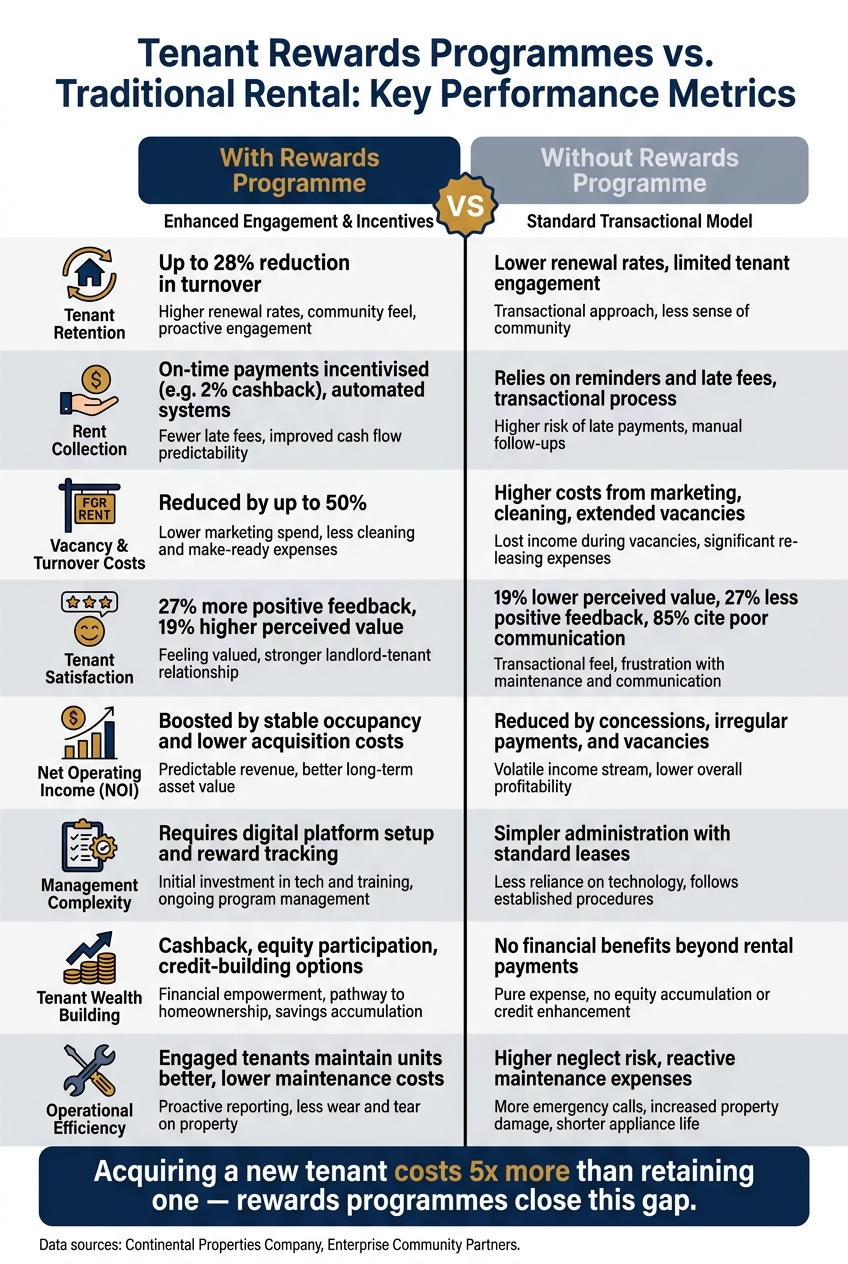
Tenant Rewards vs. No Rewards: Property Performance Metrics Compared
Tenant rewards programmes can significantly impact financial performance and tenant satisfaction. Here's a detailed comparison of properties with and without these programmes:
| Factor | Properties With Rewards Programmes | Properties Without Rewards Programmes |
|---|---|---|
| Tenant Retention | Up to 28% reduction in turnover through consistent engagement | Lower renewal rates due to limited interaction with tenants |
| Rent Collection | Encourages on-time payments (e.g., 2% cashback) with automated systems | Relies on reminders and late fees, making payments more transactional |
| Vacancy & Turnover Costs | Reduces vacancy and turnover costs by up to 50% | Higher costs from marketing, cleaning, and extended vacant periods |
| Tenant Satisfaction | 27% more positive feedback and 19% higher perceived value | Lower satisfaction and perceived value among tenants |
| Net Operating Income (NOI) | Boosted by stable occupancy and reduced tenant acquisition costs | NOI affected by concessions, irregular payments, and vacancies |
| Management Complexity | Requires effort to track rewards and build tenant trust | Easier administration with standard lease agreements |
| Wealth Building | Provides options like cashback, equity participation, and credit-building | No financial benefits for tenants beyond their rental payments |
| Operational Efficiency | Engaged tenants maintain units better, leading to lower maintenance costs | Higher risks of neglect and reactive maintenance expenses |
These comparisons highlight the financial and operational advantages of implementing rewards programmes over traditional rental models.
While rewards programmes offer clear benefits, they do require upfront effort. This includes integrating digital platforms, defining reward triggers, and building trust with tenants. However, the payoff is evident in improved cash flow and increased NOI. Rob Bachmann of Enterprise Community Partners emphasises this point:
"Part of our thesis is that this fund will actually perform better than other funds because of the wealth-building mechanics of the property. And that is because tenants will be happier, and that translates to higher occupancy, which translates to greater net operating income."
For landlords in the UAE, platforms like Rewa make managing rewards programmes simpler. These platforms automate rent collection, ensure timely payments, and allow tenants to earn rewards with over 150 partners - all while eliminating administrative fees. This creates a win-win scenario for landlords and tenants alike.
On the other hand, properties without rewards programmes face recurring turnover costs. Tenant acquisition expenses, which are five times higher than retention costs, exacerbate the financial impact of vacancies.
Conclusion
Tenant rewards programmes give UAE landlords a clear advantage. Properties that implement these systems see reduced tenant turnover, steadier rent collection, and improved net operating income. In contrast, landlords who don't adopt such programmes often face revenue losses due to inefficiencies.
Ramzi Mneimneh, Founder of Rewa, explains:
"We've applied proven loyalty models from the airline and hotel industries to rent, creating a system that rewards tenants while improving cash flow and efficiency for landlords."
Platforms like Rewa are designed specifically for the UAE market. They operate within the Dubai Land Department's Real Estate Evolution Space (REES) programme and comply with Ejari requirements. Through the Rewa Alliance, landlords can modernise their rent collection systems without setup fees, fostering tenant loyalty without increasing costs.
This approach simplifies the rent collection process and highlights a shift in the market. By adopting digital, rewards-based payment solutions, landlords can retain high-quality tenants, cut expenses, and boost long-term property value. Tenant rewards programmes are changing the game, offering smoother cash flow and stronger tenant relationships.
FAQs
How much do tenant rewards improve on-time rent payments?
Tenant rewards programmes are a smart way to encourage on-time rent payments by offering tenants redeemable points for perks like travel and dining. This approach not only motivates tenants to pay promptly but also cuts down on late payments and strengthens tenant relationships. Take Rewa as an example: it ensures landlords receive payments on time while rewarding tenants, providing a steady income flow and boosting the overall performance of the property.
Do rewards programmes increase renewals without cutting rent?
Tenant rewards programmes have the power to increase lease renewals without the need to lower rent. By providing thoughtful perks and recognising tenants' loyalty, these programmes create a sense of satisfaction and connection. They also motivate tenants to make timely payments and stay longer, reducing turnover rates. This strategy ensures steady rental income while enhancing the overall tenant experience and fostering stronger engagement.
How can landlords launch a rewards programme with Rewa?
Landlords can now streamline rent collection and offer added value to tenants using Rewa. By accepting rent payments through credit card or bank transfer, landlords can set up a rewards programme effortlessly. The platform handles the heavy lifting with features like automated tracking, digital receipts, and adherence to UAE rental regulations.
For tenants, Rewa makes paying rent more rewarding. They earn loyalty points that can be redeemed for travel, dining, and other perks. This not only enhances the payment experience but also encourages on-time payments and strengthens tenant satisfaction.