Tenant Loyalty Programs: Do They Reduce Vacancy Rates?
Loyalty programs tied to on-time payments, renewals and referrals can cut UAE vacancy costs far below the price of a move-out.
Tenant Loyalty Programs: Do They Reduce Vacancy Rates?
Yes - they can cut vacancy rates if they improve renewals, payment behaviour, and referrals at a cost far below a move-out. In Dubai, one vacant unit can cost about AED 19,000, and the usual void period is around 58 days. So if I can keep even a small number of tenants from leaving, the numbers can work fast.
Here’s the short version:
- Tenants often leave for service issues, not just rent
- On-time payment rewards can support renewals
- Renewal bonuses can cost much less than a vacant unit
- Referral rewards can help fill units with less spend
- The programme only works well if service and communication are already solid
- The main test is simple: lower vacancy days and more renewals than before
A few numbers stand out:
- AED 19,000 average reletting cost per unit in Dubai
- 58 days average void period
- 83% of tenants say repairs affect renewal decisions
- 62% prefer digital communication
- 1%–3% of annual rent is a common loyalty cost range
- 8%–15% of gross rental income can be lost to turnover
If I strip this down to one point, it’s this: a tenant loyalty programme is not a fix by itself. But when it is tied to on-time payments, early renewal offers, resident perks, and clean tracking, it can help keep units occupied and protect rental income.
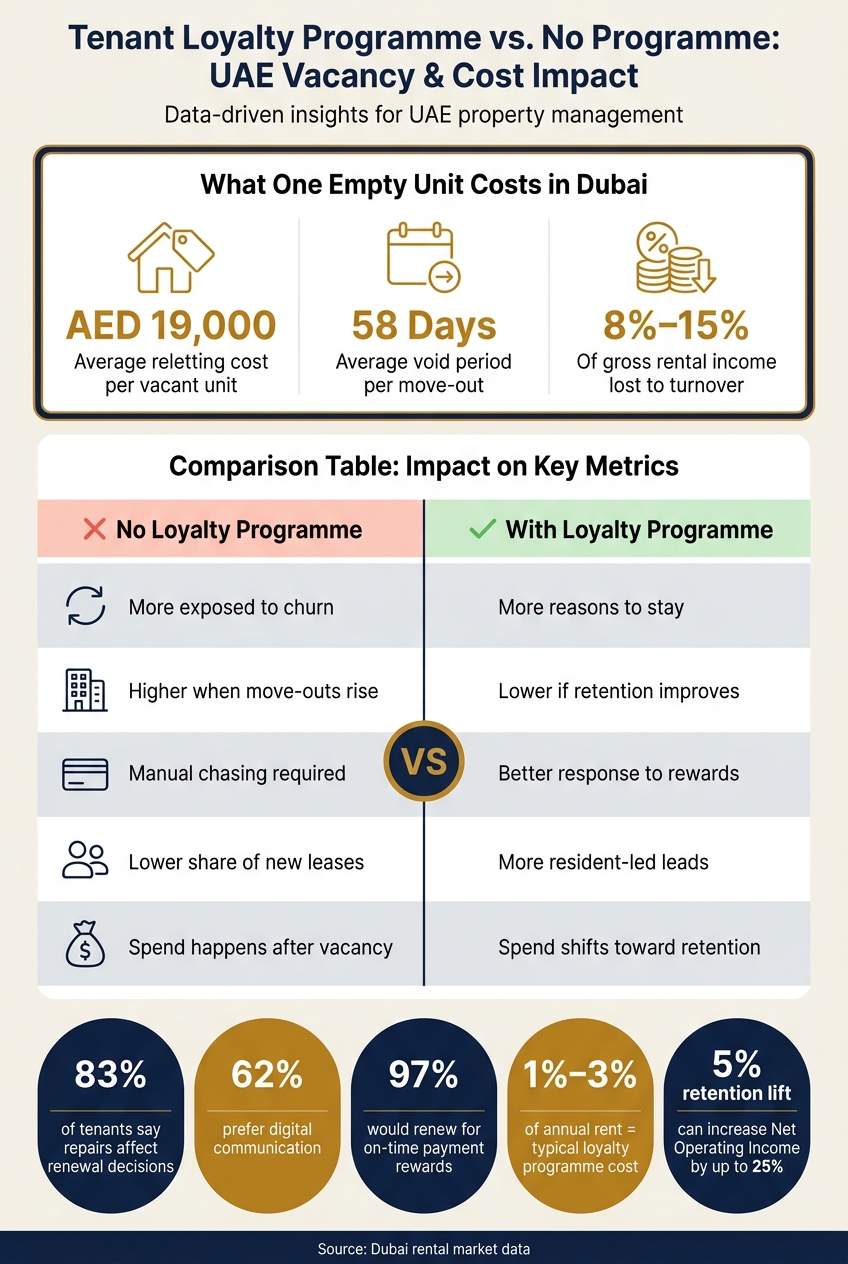
Tenant Loyalty Programme vs. No Programme: UAE Vacancy & Cost Impact
How to Create Tenant Loyalty Programs That Keep Your Tenants Happy and Your Properties Full
sbb-itb-80e96b1
Quick comparison
| Area | Without a loyalty programme | With a loyalty programme |
|---|---|---|
| Renewals | More exposed to churn | More reasons to stay |
| Vacancy days | Higher when move-outs rise | Lower if retention improves |
| Payment behaviour | More manual chasing | Better response to rewards |
| Referrals | Lower share of new leases | More resident-led leads |
| Cost control | Spend happens after vacancy | Spend shifts toward retention |
So the answer is simple: tenant loyalty programmes can reduce vacancy rates in the UAE, but only when the rewards are low-cost, easy to use, and backed by good property management.
Why Tenants Leave and Why Cutting Rent Does Not Fix It
Price matters, but it usually is not the main reason tenants move out. More often, the problem is day-to-day friction: slow maintenance, poor communication, and awkward payment processes. Those issues wear people down. Over time, they lead to more move-outs and more vacant days. In the UAE, service quality drives relocation decisions for 64% of tenants, which makes one thing clear: rent is only part of the story.
Maintenance is usually the first pressure point. 83% of tenants say timely repairs heavily influence their decision to renew. In the UAE, that hits even harder because AC failures are urgent. A delayed fix is not a minor hassle when the weather is hot. Poor communication then adds another layer of frustration, especially when tenants are left chasing updates. That matters because 62% of tenants prefer digital communication.
Payment friction adds to the churn as well. If paying rent feels slow, rigid, or annoying, it chips away at the tenant experience. On the other hand, 97% of renters say they would renew if they could earn rewards for on-time digital payments. That is why payment-linked rewards can help reduce churn before renewal even comes up.
Cutting rent does not solve any of this. A discount may help fill a unit for a short period, but it does not fix the reason people leave in the first place. Better service and a smoother payment experience do more to support renewals. They also help protect rent levels instead of pushing them down.
What Tenant Turnover Costs per Unit
A tenant departure often costs more than landlords expect. In Dubai, the average reletting cost per unit is AED 19,000, based on a typical void period of 58 days.
Here is how that cost builds:
| Cost Component | Estimated Cost / Impact |
|---|---|
| Lost rent during the void period | ~AED 14,600 |
| Agency/brokerage fee | ~5% of annual rent |
| Ejari re-registration and admin | AED 220+ |
| Owner or staff time | 60–80 hours per transition |
And that still does not include deep cleaning, make-ready repairs, or listing and marketing work.
Across a portfolio, the total can pile up fast. Once you see the cost per move-out, the next step is simple: look at which rewards and resident perks give tenants a reason to stay put.
How Loyalty Programmes Help Keep Units Occupied
Loyalty programmes help cut vacancy in three main ways: renewals, referrals, and on-time payments. The logic is pretty simple. If a single renewal avoids a full move-out, the cost of the reward can be far lower than the AED 19,000 vacancy cost it helps avoid. That said, rewards don't fix weak operations on their own. They tend to work when pricing, maintenance, and communication are already in good shape.
In most cases, the first occupancy lift comes from payment behaviour. That's because renewal decisions often take shape before formal notice periods even start.
Payment Rewards and Renewal Incentives That Drive Retention
This is where rewards can have the biggest effect. At renewal, even a small incentive can be enough to stop a tenant from leaving. Rewa, for example, gives points for on-time rent payments that tenants can redeem with partner brands. Renewal offers like rent credits, fee waivers, or unit upgrades can also help keep long-term tenants in place.
The key is to stay disciplined on cost. The incentive should remain well below what one move-out would cost.
Once payment rewards start improving retention, referral rewards can help deal with the vacancies that still happen.
Referral Rewards and Resident Perks That Support Occupancy
Referrals can fill empty units faster, and they often bring in tenants who are a better fit. Referral rewards, usually in the form of AED rent credits or cash bonuses, can cut re-letting time and reduce marketing spend at the same time.
Resident perks play a different role. Things like dining offers, fitness access, and travel discounts can make daily life feel a bit easier, which can nudge renewal decisions in the right direction. In the UAE, these perks tend to work best when they match everyday needs, such as groceries, dining, utilities, or travel, and when tenants can access them easily through digital channels.
At the end of the day, the test is pretty straightforward: do these perks lead to better renewal rates, fewer vacancy days, and more referrals?
The next question is whether those gains are large enough to outweigh the programme cost.
How to Measure Whether a Loyalty Programme Is Working
Once your reward mix is live, the next job is simple: find out if it cuts vacancy and churn enough to cover its own cost. That’s the whole test.
A practical way to do this is to compare the 12 months before launch with the 12 months after launch. Using a full-year window helps smooth out Dubai’s seasonal rental patterns, where activity tends to peak between January and March and again from August to October. If you manage a larger portfolio, set up a control building with no programme. That gives you a cleaner read on what came from the programme and what would have happened in the market anyway.
The Key Metrics: Renewal Rate, Vacancy Days, On-Time Payments, and Referrals
Track these numbers closely:
- Lease renewal rate
- Average vacancy days per unit per year
- On-time payment rate
- Referral share of new leases
- Average tenancy length in months
- Net rental income per unit in AED
If the programme is doing its job, a few things should start to show up in the data. Renewal rates should move up. Vacancy days should drop in a meaningful way. Referrals should also make up a bigger share of new leases.
One useful habit: start the renewal conversation at the 90-day mark before lease expiry, before tenants begin shopping around.
Use those figures to turn retention gains into AED savings.
Calculating ROI in AED Using a Before-and-After Model
The maths isn’t hard. Start with the total programme cost: software fees plus reward costs. Then compare that with the savings you create.
Those savings come from two main places. First, take the number of move-outs you avoided and multiply it by AED 19,000. That’s the average re-letting cost per unit in Dubai, including agent fees, void income loss, and make-good refurbishment. Second, add any cut in vacancy days and multiply that by the unit’s daily rental rate.
Here’s why this matters. A 45-day void on a unit renting at AED 90,000 per year costs about AED 11,000 in lost rent alone, even before agent fees enter the picture. Put next to that, a renewal bonus of AED 1,500–2,000 looks modest. That makes it worth testing in your model.
Judge the programme against your baseline. Occupancy and income tell the story better than gut feel ever will.
| Loyalty Lever | Primary Objective | Typical AED Cost | KPI Outcome |
|---|---|---|---|
| Payment Rewards | Reduce arrears | 0.5%–1% of rent (points) | Higher on-time payment rate |
| Renewal Bonuses | Secure lease renewal | AED 1,000–2,500 | Higher renewal rate; lower vacancy days |
| Referral Rewards | Fill vacancies faster | AED 500–2,000 | Lower acquisition cost; shorter voids |
| Resident Perks | Deepen engagement | AED 200–500 (partner deals) | Longer average tenancy length |
| Metric | Before Programme (12 Months) | After Programme (12 Months) | Target |
|---|---|---|---|
| Lease Renewal Rate | Baseline % | Measured % | +10–20% |
| Avg. Vacancy Days per Unit | Current portfolio average | Measured | Reduce materially |
| On-Time Payment Rate | Baseline % | Measured % | >95% |
| Referral Share of New Leases | Baseline % | Measured % | >15% |
| Avg. Tenancy Length | 2.3 years | Measured | +12 months |
| Net Rental Income per Unit | AED baseline | AED measured | Increase via reduced voids |
Loyalty programme spend usually sits at 1%–3% of annual rent, while tenant turnover can eat up 8%–15% of gross rental income. That spread is where the return tends to show up.
Building a Practical UAE Loyalty Programme and Final Verdict
With the ROI case in place, the next step is simple: pick rewards and tools that change tenant behaviour.
A good starting point is Dubai’s average reletting cost of about AED 19,000 per unit. That gives landlords a clear budget anchor for an annual loyalty plan. Instead of spending that money only after a tenant leaves, use part of it on low-cost perks tied to the biggest renewal drivers.
In the UAE, that can include a professional deep clean at the start of a tenant’s third year, bi-annual AC servicing, and flexible monthly payment options. These are practical levers because they deal with service pain points, and service issues drive most move decisions in the UAE. To keep things clear, landlords should log rewards, maintenance activity, and payment milestones in a digital portal so there’s a clean audit trail.
Technology, Security, and a Clear Cost-Benefit View
For these rewards to work across a full portfolio, landlords need automated tracking instead of manual follow-up.
Spreadsheets and cheque logs make it hard to run loyalty in a steady way across multiple units. Automated rent collection, real-time payment tracking, and centralised expiry alerts turn reactive admin into a more structured workflow.
Rewa is built around this workflow in the UAE. Landlords can join the Rewa Alliance with no setup fees. Tenants pay rent by credit card or bank transfer and earn points on every on-time payment. Those points can be redeemed across more than 150 partners or used toward future rent and utilities. Automated rent collection, on-time payment tracking, and DLD/Ejari-aligned records sit in the same system.
When rewards are tied directly to payments, renewals, and lease alerts, vacancy control stops being a marketing idea and becomes something landlords can track.
| Metric | No Loyalty Programme | Technology-Enabled Programme (Rewa) |
|---|---|---|
| Turnover Cost per Unit | High (average AED 19,000) | Lower turnover cost through fewer move-outs |
| Annual Vacancy Days | Longer voids from late renewal follow-up | Shorter voids through earlier renewals and referrals |
| On-Time Payment Rate | Variable; manual follow-ups required | Higher; driven by automated reward points |
| Portfolio Visibility | Fragmented; spreadsheets and calendars | Centralised; real-time tracking and digital receipts |
| Tenant Experience | Transactional and reactive | More useful and more timely |
The numbers shared earlier make the verdict pretty clear. Loyalty programme spend usually sits at 1%–3% of annual rent, while tenant turnover can eat 8%–15% of gross rental income. On top of that, a 5% improvement in retention can lift Net Operating Income by up to 25%.
The model works when three things connect: rewards, automation, and measurement. That’s where the return shows up.
FAQs
Which tenant rewards work best in the UAE?
In the UAE, the tenant rewards that work best are the ones that make renewals feel simple and hassle-free.
That usually includes:
- On-time rent incentives
- Loyalty points that tenants can use with lifestyle partners or put towards future rent or utilities
- Renewal bonuses, such as rent discounts
- Small property-upgrade gestures, like deep cleaning or a light cosmetic refresh
App-based resident portals can help too. They make it easier to track points and payments, and they cut down friction during the renewal process.
How much should a loyalty programme cost per unit?
There’s no fixed industry-standard cost per unit. Loyalty programmes are usually shaped around each property’s needs, goals, and budget.
The main benchmark is simple: the programme should cost less than resident turnover. That turnover can reach or exceed AED 14,700 per unit once you factor in lost rent, maintenance, and marketing.
That’s why many property managers look at spend through an ROI lens. If the programme helps cut churn, the maths often starts to make sense fast.
How long does it take to see lower vacancy rates?
There’s no one-size-fits-all timeline for every property. Even one vacant unit can hit your numbers hard, with vacancy, marketing, and maintenance costs often landing between AED 9,200 and AED 14,700 per unit.
That kind of loss isn’t small. In many cases, it can take six months or more to make that money back.
That’s where loyalty programmes can help. They can support renewals and make occupancy more stable over time. But they’re not a quick patch. They tend to work best when you treat them as a long-term plan built on data, not as an instant fix for empty units.