Late Rent Payments: 5 Solutions for Property Managers
Late rent is usually a process problem: use reminders, AED online payments, flexible plans, rewards, and clear late-fee rules.
Late Rent Payments: 5 Solutions for Property Managers
Late rent is usually a process problem, not just a tenant problem. If I want fewer missed due dates in a UAE portfolio, I need five things working together: scheduled reminders, AED online payments, written payment plans, tenant rewards, and clear late-fee rules.
Here’s the short version:
- Reminders cut missed dates before they happen.
- Online payments and autopay remove cheque and manual transfer delays.
- Flexible payment dates or instalments can help tenants match rent to their salary cycle.
- Rewards give tenants a reason to pay on time.
- Late-fee rules work best when the contract states the due date, grace period, fee amount in AED, and notice steps.
The article also makes two clear points: manual collection adds admin work, and digital payment tools can cut processing time by up to 70%. For me, that means less time chasing rent and better visibility across the portfolio.
Quick Comparison
| Solution | What it does | Main effect |
|---|---|---|
| Automated reminders | Sends notices before and after due dates | Fewer missed payments |
| Online AED payments and autopay | Lets tenants pay by card, bank transfer, or recurring setup | Smoother cash flow |
| Flexible payment plans | Aligns rent dates with tenant income | Fewer repeat late cases |
| Reward-based payments | Adds loyalty points or partner perks | Better on-time payment behaviour |
| Clear late-fee rules | Sets fixed rules for delays and notices | Stronger enforcement |
If I had to keep it simple, I’d say this: make payment easy, make dates clear, and make follow-up automatic.
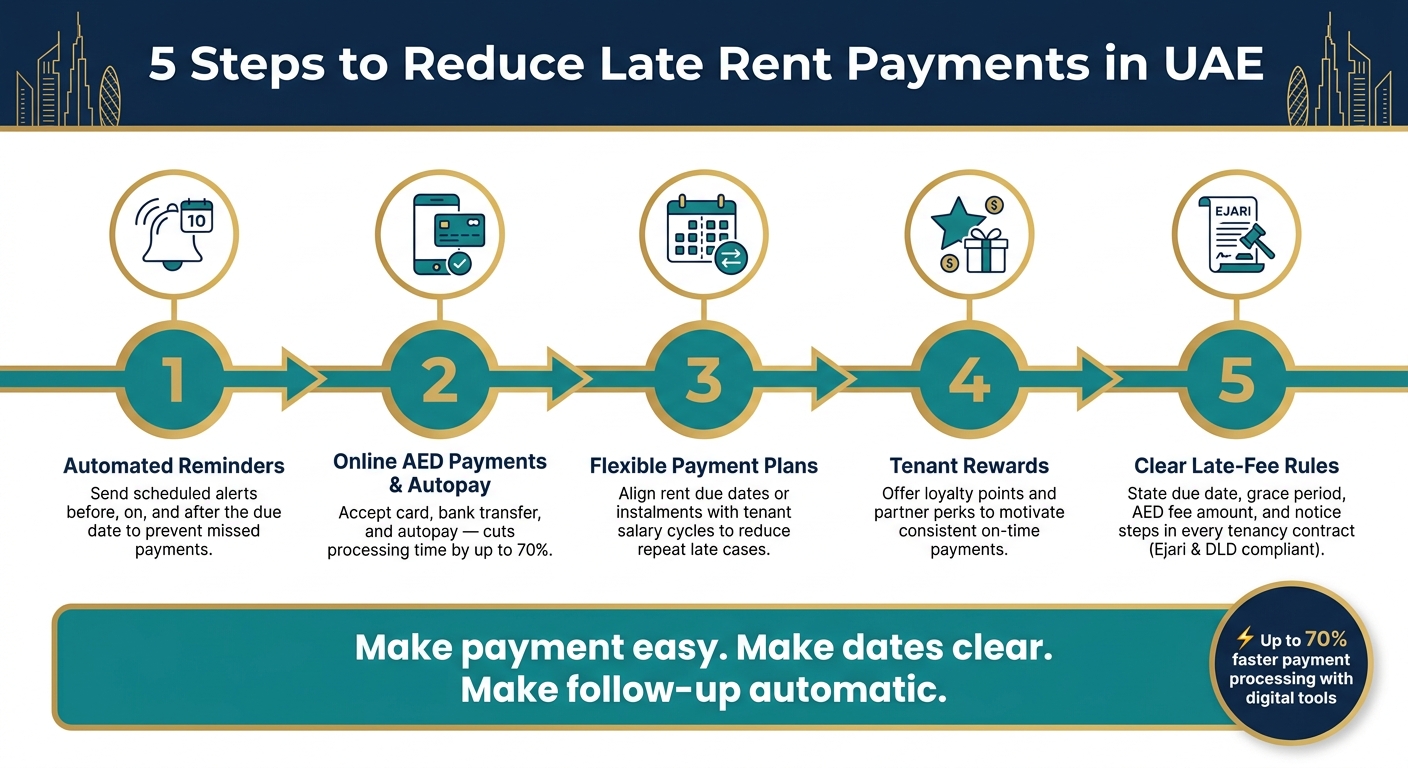
5-Step Rent Collection Process for UAE Property Managers
Solutions 1 and 2: Automate Reminders and Simplify Payment
1. Set up automated rent reminders on a fixed schedule
Start with the simple fix: make rent hard to miss and easy to act on.
Set automated reminders to go out before the due date, on the due date, and after any grace period. That simple rhythm can cut missed dates and reduce the back-and-forth of chasing collections. You can also automate payment tracking and digital receipts, which gives your team better visibility and cuts reconciliation time.
2. Offer online payment portals and autopay in AED
Post-dated cheques and manual follow-up still slow rent collection across many UAE portfolios. An AED payment portal helps remove that friction.
Give tenants a simple way to pay with:
- Card payments
- Bank transfers
- Autopay
Autopay and recurring payment options can reduce missed due dates and make cash flow easier to predict for landlords. In plain terms, fewer tenants slip through the cracks, and your team can move faster on follow-up. It can also cut payment processing time by up to 70%.
If some tenants still miss dates, the next step is adding flexibility without giving up control.
sbb-itb-80e96b1
Solutions 3 and 4: Use Flexibility and Incentives to Get Rent Paid on Time
3. Offer flexible payment dates and written payment plans
Where the lease allows it, you can split rent into fixed instalments or shift the due date so it lines up with the tenant’s income cycle. That can make a big difference. A tenant who gets paid mid-month may keep slipping if rent is due at the start of the month.
The key is to keep the setup simple and firm. Put every arrangement in writing, keep the dates fixed, and track everything in one central place so your team has a clear view without extra follow-up.
If timing changes still don’t fix late payments, it helps to add a clear reason for tenants to pay on time.
4. Use tenant rewards to encourage on-time rent payments
Flexibility helps with timing. Rewards help with motivation.
A reward can turn rent from “just another bill” into something with a small upside. Rewa lets tenants pay by credit card or bank transfer while earning loyalty points that can be redeemed with partner rewards. In some cases, those points can also go toward future rent or utility payments with select UAE developers.
For property managers, that can mean steadier cash flow and fewer follow-ups. For tenants, it makes the payment process feel less like a chore and more like a routine with a perk attached.
Comparison table: Standard portals vs reward-based payments vs traditional collection
| Feature | Traditional Collection | Standard Digital Portals | Reward-Based Payments (Rewa) |
|---|---|---|---|
| Tenant incentive | None | Convenience only | Loyalty points and partner rewards |
| Admin workload | High | Moderate | Low |
| Cash flow visibility | Reactive | Better than manual | Predictable |
| On-time payment rates | Variable | Improved | Stronger |
| Tenant experience | Low | Neutral | High |
If flexibility and rewards still miss the mark, the next step is consistent late-fee enforcement.
Late Paying Tenant? Here's What You Should Do
Solution 5: Set Clear Late-Fee Rules and Apply Them Consistently
If reminders, payment options, flexibility, and rewards still don’t get rent in on time, the last control is a clear late-fee policy.
Late fees only work when the rule is easy to understand and used the same way for every tenancy. If one case gets a fee and another doesn’t, disputes start, notices get delayed, and collections lose force.
5. Write late-fee policies that are clear, documented, and applied through a fixed workflow
The aim isn’t to punish tenants. It’s to set a rule people understand and that managers can apply right away.
Each tenancy contract should clearly state the due date, grace period, late fee in AED, payment method, and notice timeline. Put these terms in the tenancy contract and make sure the workflow matches Ejari and DLD requirements. If the policy isn’t written down clearly, it becomes far harder to enforce when a dispute comes up.
The main challenge is consistency. Automated tracking, receipts, and notices cut down on manual follow-up and improve record accuracy. When the workflow runs on autopilot, the same rules and records are used every time. That gives property managers a cleaner audit trail for each payment event.
Once the fee rule is fixed and automated, collections become easier to enforce across the whole portfolio.
Comparison table: Flat late fee vs percentage fee, and short vs longer grace periods
The next step is deciding how to set the fee and the grace period.
| Feature | Flat Late Fee | Percentage-Based Fee | Short Grace Period (1–3 days) | Longer Grace Period (5–7 days) |
|---|---|---|---|---|
| Predictability for tenant | High - fixed AED amount known in advance | Variable - depends on rent amount | Clear deadline, less ambiguity | More buffer, but risk of making late payment feel normal |
| Ease of enforcement | Simple to apply and explain | Needs calculation for each unit | Faster escalation | Delays enforcement action |
| Cash flow impact | Steady recovery per late event | Higher recovery on larger rents | Tighter collection cycle | Longer gap before fee starts |
| Dispute risk | Low when written into the contract | Moderate if not explained clearly | Low if shared upfront | Higher if tenants start testing the limit |
| Best suited for | Portfolios with mixed rent levels | High-value or premium units | Portfolios with strict collection targets | Portfolios focused on tenant retention |
With the rule set, the process can run the same way across every rent cycle.
Conclusion: Build a Rent Collection Process That Reduces Late Payments
Late rent rarely comes down to just one issue, so a single fix usually won’t do much on its own. These five solutions work best when they run as one clear process.
Here’s how that looks in practice: automated reminders help stop missed due dates before they happen, digital payments and autopay in AED remove the hassle of manual steps, flexible payment options give good tenants some breathing room when timing gets tight, tenant rewards give people a clear reason to pay on time, and consistent late-fee enforcement, built into workflows that line up with DLD and Ejari, steps in when the other parts don’t work.
For property managers, that means steadier cash flow and less time spent chasing payments. For tenants, it creates a simpler system and a clearer reason to stay on track.
In day-to-day use, each part helps both cash flow and the tenant experience:
| Element | Impact on Property Manager | Impact on Tenant |
|---|---|---|
| Automated Reminders | Reduces manual chasing and admin work | Prevents accidental late payments |
| Digital Payments | Predictable cash flow; no manual cheque handling | Seamless, modern payment experience |
| Flexible Payment Options | Higher retention and portfolio stability | Reduced financial stress |
| Tenant Rewards | Incentivises on-time payment; improves behaviour | Gains value from a major monthly expense |
| Late-Fee Rules | More disciplined operations; DLD/Ejari compliance | Clear expectations and fair treatment |
Taken together, these five elements help reduce late payments, cut manual work, and improve record accuracy across the portfolio.
FAQs
How do I reduce repeat late rent cases?
Reduce repeat late rent cases by moving away from manual tracking and into automated digital tools. A simple online payment portal, paired with automated reminders, makes it easier for tenants to pay before the due date and cuts down the back-and-forth of chasing payments.
You can also add a reward incentive programme to nudge more residents toward on-time payments. Used together, these tools give you better visibility over incoming rent, help make cash flow more predictable, and support stronger resident compliance.
When should I offer a payment plan?
Offer a payment plan when a tenant keeps paying late or is going through a short-term cash crunch but wants to remain in the property. This can help protect cash flow and keep a good tenant in place.
A structured, automated payment schedule makes rent collection more predictable, cuts admin time, and replaces manual follow-up with a clearer, more professional process.
What should a late-fee clause include?
A clear late-fee clause should spell out the grace period, the exact fee amount or percentage, and the point at which the fee applies.
To work well within the UAE rental framework, the clause should appear clearly in the tenancy agreement. That puts expectations on the table from day one, makes enforcement more consistent, and cuts down on manual follow-ups.