How Rewards Programs Boost Retention
Rent-linked rewards encourage on-time digital payments, boost lease renewals, and cut admin work for landlords.
How Rewards Programs Boost Retention
If I want tenants to stay longer, rewards can help - but only when they are tied to rent payments, easy to use, and backed by good service.
In the UAE, rent is a repeated cost, and that gives landlords more than one chance to shape tenant behaviour. With 1.38 million tenancy contracts recorded in Dubai in 2025, even a small lift in renewals can matter. A rent-linked rewards programme can help me push three things at once: on-time payment, digital payment use, and lease renewal.
Here’s the short version:
- One-off discounts help at move-in, but their effect often ends there.
- Rewards programmes keep giving value across the full 12-month lease.
- Points, cashback, and perks can make tenants more likely to pay on time and think twice before moving.
- Data matters: payment history, app use, redemptions, and lease records show what is working.
- Personalisation matters: families and younger tenants often use rewards in different ways.
- Good service still matters: rewards won’t fix poor communication or a bad rental experience.
- Digital tools can cut cheque chasing, reduce manual admin, and give landlords a clearer view of collections.
I’d look at rewards as a retention tool, not just a perk. The goal is simple: make rent payments feel worth doing on time, every month, while giving landlords a cleaner way to track renewals, payment habits, and tenant interest.
A practical UAE example is Rewa, which lets tenants pay rent by card or bank transfer, earn points, and use those points on travel, dining, groceries, retail, or even future rent. In June 2026, its partnership with haus & haus showed how this model can work across a managed portfolio.
If I were setting up a programme like this, I’d keep it focused on three things: easy earning, useful rewards, and clear tracking.
| Area | What matters most | Why it helps retention |
|---|---|---|
| Payment behaviour | On-time rewards | Builds monthly payment habits |
| Tenant loyalty | Points and redemptions | Makes staying feel worth more |
| Digital use | App, card, or bank transfer payments | Cuts friction in paying rent |
| Service quality | Clear support and smooth processes | Stops rewards from feeling pointless |
| Reporting | Renewal rate, late days, redemption rate | Shows if the programme is working |
That’s the main idea of the article: rewards work best when they are simple, linked to behaviour, and measured against renewals.
How rewards programmes influence tenant behaviour
How on-time payment rewards build stronger payment habits
On-time rewards can turn rent payment into a simple repeat pattern: pay on time, earn points, use those points for something useful. It’s a clear exchange, and that matters. Each on-time payment strengthens the habit while the points balance keeps growing. On top of that, digital payment tools help cut delays by replacing manual cheque-based payments.
As that balance builds up over time, the effect can move beyond monthly payment behaviour. It can start to shape renewal decisions too.
How points, tiers, and earned value increase loyalty
Accumulated points make leaving feel more costly. The longer tenants stay, the more earned value they may lose if they move elsewhere.
That same loyalty model works in residential leasing. If points can be used for rent, utilities, and lifestyle spend, the value of renewing becomes easier to see.
Rewa uses airline-style loyalty mechanics for rent, tying tenant rewards to landlord cash flow and efficiency.
Still, rewards only land well when the rental experience itself is smooth and transparent.
Why rewards work best alongside fair pricing and good service
Rewards can help push a tenant towards renewal, but they can’t do all the heavy lifting. If a tenant is dealing with poor communication, slow replies, or a clunky rental experience, points alone won’t be enough to keep them around.
That’s where good property management comes in. When digital convenience, clear communication, and reliable service are already there, a well-built rewards programme can give tenants that extra nudge to renew.
The next question is which tenant behaviours show whether these rewards are improving retention.
sbb-itb-80e96b1
How to Create Tenant Loyalty Programs That Keep Your Tenants Happy and Your Properties Full
How data helps operators improve retention with rewards
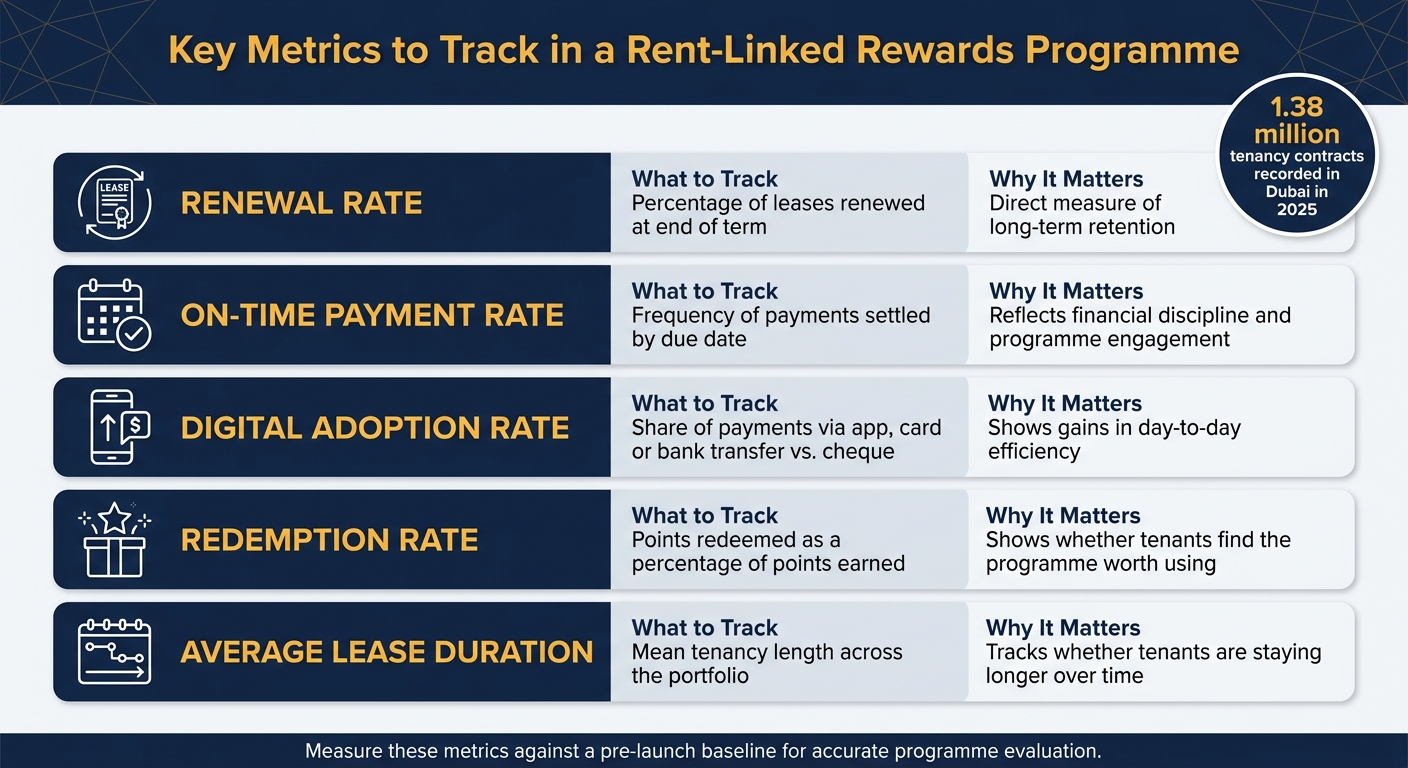
Key Metrics to Track in a Rent-Linked Rewards Programme
Once rewards start shaping behaviour, data shows what happens next. You can see which tenants respond, which habits stick, and whether those changes lead to renewals.
Which tenant data points matter most
For UAE operators, the most useful signals usually come from payment history, app engagement, redemption patterns, and verified lease data.
Payment history is the clearest place to start. Track on-time and late payments, along with digital payment adoption, to set a clean baseline for financial behaviour. Then add redemption patterns as the next layer. If tenants keep choosing travel, retail, groceries, dining, or lifestyle rewards, that gives operators a clear read on what people use in practice, not just what they say they want.
In the UAE, verified data carries extra weight. UAE Pass and Ejari-linked records help keep tenancy data verified and secure, which supports cleaner segmentation and more dependable renewal analysis.
Those inputs only matter if they connect payment behaviour to renewal outcomes.
How to personalise rewards by tenant segment
Redemption data makes segmentation far more practical. Families often use rewards to cut routine household costs, such as groceries. Younger residents aged 18 to 24 tend to lean more towards points-based progression and lifestyle perks like dining and travel. That’s why personalisation works best when it follows actual usage patterns instead of guesswork.
Portfolio dashboards make this easier across multiple buildings. Operators with properties in Dubai and Abu Dhabi can use redemption analytics to spot which communities are engaging, then adjust the reward mix based on what the data shows.
Which metrics show whether retention is improving
The clearest view comes from tracking a small group of payment and retention metrics against a pre-launch baseline. Start by recording average days late, cheque bounce rates, and manual reconciliation time. Then compare those figures with post-programme results.
| Metric | What to Track | Why It Matters |
|---|---|---|
| Renewal Rate | Percentage of leases renewed at end of term | Direct measure of long-term retention |
| On-Time Payment Rate | Frequency of payments settled by due date | Reflects financial discipline and programme engagement |
| Digital Adoption Rate | Share of payments made via app, card or bank transfer versus cheque | Shows gains in day-to-day efficiency |
| Redemption Rate | Points redeemed as a percentage of points earned | Shows whether tenants find the programme worth using |
| Average Lease Duration | Mean tenancy length across the portfolio | Tracks whether tenants are staying longer over time |
What rent-linked rewards look like in practice
Once operators know which tenants are likely to respond, the next step is simple: make the reward experience easy to use every month.
How app-based rent rewards improve the resident experience
App-based rent rewards work best when tenants can pay rent, track points, and redeem them in one place. That ease matters. Tenants can watch their points balance grow after each payment and use those points for travel, retail, dining, groceries, or even future rent. When it all happens inside the same app, the habit tends to stick.
For landlords, the upside is just as clear. Automated tracking and digital receipts reduce cheque chasing and reconciliation work. Real-time dashboards also give property managers a direct view of who has paid and when.
Rewa follows this model by bringing payment, points, and redemption into one flow.
A UAE example: Rewa
Rewa shows how this model works in the UAE. The platform lets tenants pay rent by credit card or bank transfer while earning Rewa Points. Those points can be redeemed for travel, retail, dining, groceries, or future rent through a network of more than 150 global and local partners.
In June 2026, Dubai-based real estate agency haus & haus entered an exclusive three-month distribution partnership with Rewa. The deal let tenants across its managed portfolio pay digitally and earn points, while giving landlords automated reconciliation and portfolio-level collection analytics. It also supports automated receipts and verified tenancy records.
That’s the core value of rent-linked rewards: simpler payments for landlords and a clear reason for tenants to stay.
Conclusion: Key principles behind retention-focused rewards programmes
One takeaway stands out: rewards programmes work best when they’re simple, relevant, and linked to payment behaviour.
What landlords and operators should act on
Set up rewards for on-time payments automatically. Offer redemptions tenants will use. And run the whole programme through secure digital payments.
When landlords and operators look at renewal rates, redemption frequency, and payment reliability together, they get a much clearer view of what’s paying off. Keep the offer simple, too. Tenants should be able to see what they earn and how to use it straight away.
The best programmes turn rent into a habit tenants care about and landlords can measure.
FAQs
How quickly can rewards improve renewals?
Rewards can help improve renewals over time by nudging tenants toward on-time and digital payments. For landlords, that can mean steadier cash flow. For tenants, it makes paying rent feel simpler and less of a chore.
There’s also a people side to this. When tenants get clear value back from a major recurring expense, satisfaction can go up. And when payment friction drops, disputes tied to late or manual payments may ease too. That can support stronger long-term retention.
What rewards do tenants value most?
Tenants care most about rewards that make their biggest monthly cost work harder for them. With Rewa, that means earning points for paying rent on time.
The options tenants tend to value most are:
- Redeeming points across travel, retail, groceries, dining, and lifestyle
- Putting points towards future rent or utility bills
- Supporting long-term housing goals with select developers
- Converting points into airline miles
It’s a simple idea: turn a monthly payment into something you can actually use, whether that’s your next flight, your grocery spend, or part of a future housing plan.
How can landlords measure if a rewards programme is working?
Landlords can judge how well a rewards programme is working by checking Rewa’s real-time dashboards. The main things to watch are payment trends, on-time rent collection, and payment reliability.
They can also look at day-to-day signs that show what’s changing on the ground: fewer manual reconciliation tasks, fewer payment disputes thanks to digital receipts and audit trails, and stronger tenant satisfaction. Taken together, these signals help show whether tenant retention is getting better.