How Predictive Tools Reduce Tenant Default Risk
Use predictive scoring to flag rent-payment risk, verify alerts with human review, protect tenant data and reduce arrears in the UAE.
How Predictive Tools Reduce Tenant Default Risk
I use predictive tools to flag rent-payment risk - not to decide that a tenant will default. My starting point: check late, failed and partial payments against the lease, verify affordability, and review each alert before contacting the tenant.
For UAE landlords, I’d keep the process simple:
- Check the score: use verified records, match the instalment schedule and test predictions against actual payment outcomes.
- Review before acting: rule out payment errors, hear the tenant’s explanation and check local notice and dispute rules.
- Protect tenant data: collect only what you need, limit access and explain how records can be corrected.
- Keep collection separate: Rewa handles rent payments, not risk scoring.
- Measure results: compare arrears in AED, on-time payments and false alerts against a 6–12-month baseline.
My rule: <u>an alert starts a review, not a penalty</u>. The aim is earlier follow-up, backed by records - not automatic decisions.
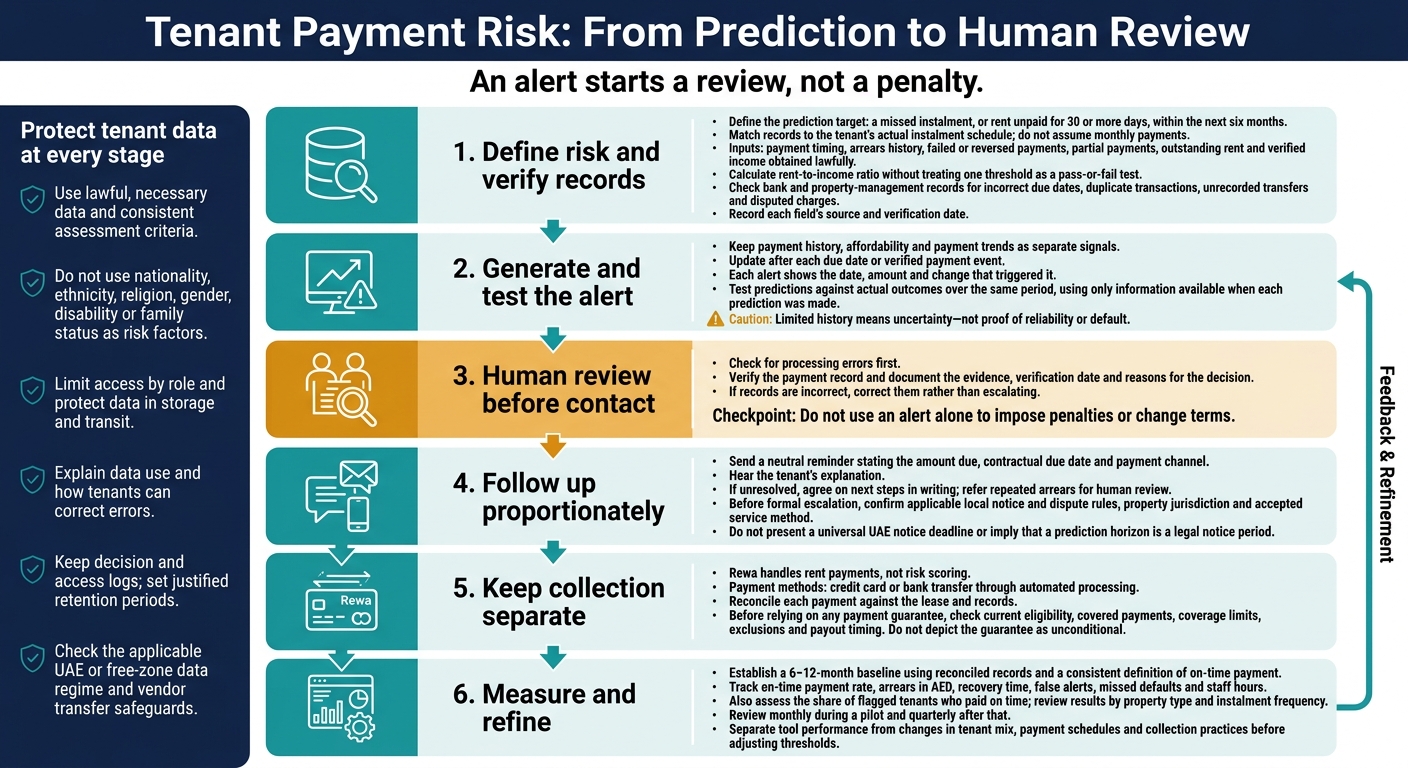
Tenant Payment Risk: From Prediction to Human Review
Real Estate Revolution: Data Science Applications Explained
sbb-itb-80e96b1
How Predictive Tools Estimate Payment Risk
Build the risk score using payment signals you already track. Start by defining the event and time frame: a missed instalment, or rent unpaid for 30 or more days, within the next six months. Ask the provider to show the lookback period, data inputs and main factors behind the score. Use the estimate to prompt follow-up, not automatic rejection.
Combine Rental History and Affordability Data
Bring together payment timing, arrears history, failed or reversed payments, partial payments, outstanding rent and verified income obtained lawfully. Calculate the rent-to-income ratio, but don’t treat one threshold as a pass-or-fail test.
Match the model to the tenant’s actual instalment schedule rather than assuming monthly payments. Use these inputs to support alerts throughout the lease.
Look Beyond Credit Scores
Treat payment history, affordability and payment trends as separate signals. They answer different questions: was rent paid, do future instalments look affordable, and are payments becoming less reliable?
Update the assessment after each due date or verified payment event. Every alert should show the date, amount and change that triggered it, so staff can tell a processing error from a genuine decline in payment reliability.
Check Data Quality and Test Risk Scores
Bad data leads to bad decisions. Before relying on a score, cross-check records against bank and property-management data. Incorrect due dates, duplicate transactions, unrecorded transfers and disputed charges can all distort the result. Record each field’s source and verification date. Limited history means uncertainty - not proof that a tenant is reliable or likely to default.
Test past predictions against actual outcomes over the same period, using only information available when each prediction was made. Track false alerts, missed defaults and the share of flagged tenants who paid on time. Review results by property type and instalment frequency. Reassess the model when payment methods or portfolio patterns change, and report only accuracy that has been tested.
Act on Risk Alerts Before Arrears Build
When a model flags risk, verify the facts before taking action.
Set Checks Before and During the Lease
Review the payment record before contacting the tenant about a risk score. Record the evidence, the verification date and the reasons for your decision. During the lease, track failed, reversed and partial payments, along with any unpaid balance.
Check for processing errors first. Then send a neutral reminder with the amount due, the contractual due date and the payment channel. If the issue remains unresolved, agree on the next steps in writing. Refer repeated arrears for human review.
Do not use an alert alone to impose penalties or change terms. Before formal escalation, check the notice and dispute rules that apply in the relevant emirate.
Compare Screening, Monitoring and Follow-Up
Keep screening, monitoring and follow-up as three separate steps. Each answers a different question and calls for a different response.
| Approach | Timing | Data used | Landlord action | Principal limitation |
|---|---|---|---|---|
| Predictive screening | Before signing or renewing | Verified identity, income, affordability indicators, lawful rental history and other lawful inputs | Estimate risk and identify what needs further verification | Estimates probability; it does not prove that a tenant will default |
| Payment monitoring | During the lease | Due dates, received amounts, failed transactions, reversals, partial payments and balances | Spot changes, investigate errors and send proportionate reminders | Shows what happened, but not necessarily why |
| Manual follow-up | After an alert or unresolved payment | Transaction records, the tenant’s explanation and communications | Clarify circumstances, correct records or refer for human review | Takes time and requires consistent judgement |
If reminders and review do not resolve the issue, use a payment process that makes rent collection simpler.
Use Rewa for Rent Collection
Rewa is a rent-payment and collection service, not a predictive scoring tool. Tenants can pay by credit card or bank transfer through automated processing. Rewa says it guarantees on-time rent payments for landlords with no fees.
Before relying on that guarantee, check the current terms for eligibility, covered payments, coverage limits, exclusions and payout timing.
Protect Tenant Data and Follow UAE Rules
When an alert appears, focus on data controls and legal compliance.
Use Consistent Criteria and Human Review
Set your criteria before assessing tenants: verified affordability, documented payment history and past arrears. Apply the same criteria to comparable applicants, and document any legitimate reason for an exception. Do not treat nationality, ethnicity, religion, gender, disability or family status as risk factors.
Tell tenants which data you used, why their result changed and how they can correct errors. Use the score to prompt a review - not to make an automatic decision.
Keep a decision log covering the data source, date, purpose, score version, key changes, alerts, tenant explanations, review and final action. Record who accessed or changed the information. Set retention periods based on the documented purpose and any legal, contractual or dispute needs. Do not store data indefinitely.
Limit Data Collection and Control Access
Under Federal Decree-Law No. 45 of 2021, identify the lawful basis for each use of tenant data. Consent does not replace duties around legality, transparency, security or purpose limitation. Collect only what you need to assess rental risk. Explain how you use the data, who receives it, how long you keep it and how tenants can correct it in your privacy notice and tenancy documentation. Check whether a free-zone regime, including ADGM, applies.
Limit access by role, protect data in storage and transit, and promptly remove access when employees leave. Before linking a predictive tool to payment records, check the vendor’s hosting locations, overseas support access, subcontractors and deletion arrangements. Verify safeguards for cross-border transfers. A payment guarantee does not remove these duties. Once you have checked data legality and security, review notice and service requirements.
Check Local Notice and Dispute Rules
Treat alerts as internal flags, not proof of a breach. Before sending a notice, confirm the rent due date, amount, contractual grace period, legally accepted service method and property jurisdiction. For Dubai matters, retain proof of service and check current RDC requirements.
Dubai Rental Disputes Center materials identify failure to pay rent, in full or in part, within 30 days of notification as a potential ground for action. Verify the applicable terms for remedying the non-payment. Dubai procedures do not apply across all emirates or free zones. Check the correct forum and current requirements before taking action.
Conclusion: Combine Prediction, Review and Collection
After alerts and follow-up, check whether the process is reducing arrears. Reliable rental and affordability data helps flag payment risks, but prediction, review and collection work best as one process. Use predictions to prioritise action.
Use Rewa as the collection layer to support this workflow, then reconcile each payment against the lease and your records. Compare results with the previous period to check whether the workflow is working better.
Measure Results Against a Baseline
Set a baseline using the last 6–12 months of records. Define what counts as on time, reconcile payment records and set alert thresholds. Assign reviewers to verify alerts before contacting tenants.
Use those same payment records to test alert quality and the effect on your portfolio. Track the on-time payment rate, arrears in AED, recovery time, false alerts, missed defaults and staff hours.
Review results monthly during a pilot and quarterly after that. Before adjusting thresholds or follow-up, separate tool performance from changes in tenant mix, payment schedules and collection practices.
FAQs
How can I assess tenants with no rental history?
Assess tenant reliability with verified digital data. Use UAE Pass to check the tenant’s identity, confirm their legal status and match their details to their registered Ejari contract.
Then track payments through digital platforms against a consistent schedule. Check whether the tenant adopts automated payments and pays the first few instalments on time. This sets a baseline for their financial behaviour and reliable cash flow, using real-time data rather than historical references.
How do I set fair rent-risk alert thresholds?
Track portfolio KPIs in this order: on-time collection rate, average days late, arrears share and autopay adoption. Lower autopay adoption usually signals higher risk.
Use real-time dashboards and notifications to flag failed or overdue payments. Escalate automated reminders to formal notices once the due date and contractual grace period have passed.
Apply policies consistently across tenancies. Clearly document due dates, grace periods, and late-fee and notice timelines in leases.
How can I tell if predictive tools are cost-effective?
Before putting the tools in place, record your on-time payment rates, cheque bounce rates, and staff hours spent on manual collections and reconciliation. Once the tools are running, use your dashboard to compare those baseline figures with post-implementation data.
Fewer manual tasks, fewer days of late rent, and higher on-time collection rates show whether the tools are cost-effective by cutting running costs and making cash flow more predictable.