Future of Rent Payments: Automation and Rewards
UAE rent is moving from cheques to secure automated monthly payments with rewards, cutting admin for landlords and easing tenants' cashflow.
Future of Rent Payments: Automation and Rewards
The way tenants and landlords handle rent in the UAE is transforming. Traditional cheque-based payments, used by 90% of tenants in Dubai, are being replaced by digital platforms offering flexibility and rewards. These systems allow tenants to pay rent monthly, aligning with salary cycles and easing financial stress. At the same time, landlords benefit from on-time payments and reduced administrative tasks.
Key highlights:
- Digital payment platforms: Enable monthly instalments, replacing 1–4 post-dated cheques.
- Rewards programmes: Tenants earn loyalty points redeemable at retailers like Amazon and Carrefour.
- Government initiatives: Support automation through systems like Ejari and UAE Direct Debit System (UAEDDS).
- Security and compliance: Platforms follow UAE Central Bank regulations, ensuring secure transactions.
- Rewa: A standout platform offering fee-free rent payments, double rewards, and seamless landlord-tenant experiences.
This shift aligns with Dubai's Cashless Strategy, aiming for 90% digital transactions by 2026, making rent payments more convenient and rewarding for all parties involved.
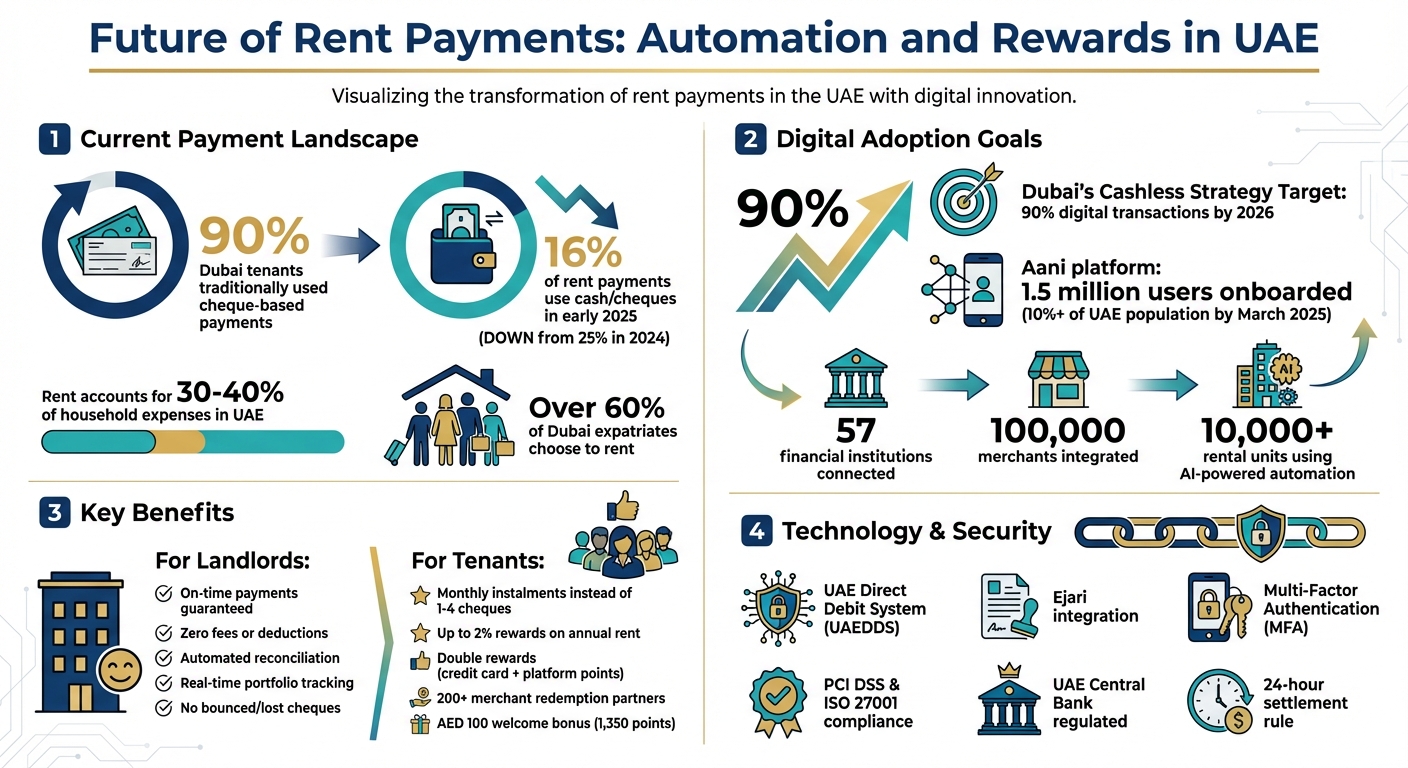
UAE Digital Rent Payment Transformation Statistics and Benefits
Technologies Behind Automated Rent Payments
Automated Payment Systems and Transaction Security
The UAE has embraced advanced technologies to make rent payments more efficient and secure. At the heart of this transformation is the UAE Direct Debit System (UAEDDS), which works seamlessly with Ejari to enable scheduled rental deductions directly from tenants' bank accounts.
In March 2024, UAEDDS joined forces with Keyper to launch "Rent Now Pay Later." This service automates monthly rent payments while allowing landlords to receive the full annual rent upfront. Omar Abu Innab, Co-founder and CEO of Keyper, highlighted this shift by saying:
"Cheques are a relic of the past. Our solution addresses longstanding dissatisfaction with cheque-based transactions, offering functionality and security with minimal friction."
Another significant development is the Aani instant payment platform, created by Al Etihad Payments in collaboration with Accenture. By March 2025, Aani had onboarded over 1.5 million users - more than 10% of the UAE’s population - and connected 57 financial institutions and 100,000 merchants. The platform supports secure, real-time payments around the clock, using simple identifiers like mobile numbers or national IDs instead of complicated bank details. Jan Pilbauer, CEO of Al Etihad Payments, remarked:
"Accenture had the technical expertise, scale and experience to help us lay the right foundation for an entirely new financial services ecosystem."
Additionally, digital wallets like noqodi have simplified recurring payments and improved dispute resolution. These wallets are now directly integrated with Ejari for rental transactions. The impact is evident: by early 2025, only 16% of rent payments in the UAE were made using cash or cheques, a sharp drop from 25% the previous year.
These advancements are underpinned by a commitment to strict regulatory standards, ensuring smooth and secure operations.
Security Standards and UAE Financial Compliance
The effectiveness of automated rent payment systems depends on their compliance with UAE’s rigorous financial regulations. These systems must adhere to frameworks set by the Central Bank of the UAE (CBUAE), including the Retail Payment Services and Card Schemes (RPSCS) Regulation (Circular No. 15/2021). This regulation outlines capital reserve requirements for payment providers based on transaction volumes. For instance, providers handling less than AED 10 million in monthly transactions need AED 100,000 in initial capital, while those exceeding AED 10 million require AED 500,000.
Security measures are equally stringent. Providers must implement Multi-Factor Authentication (MFA), which combines at least two verification methods, such as passwords, tokens, or biometrics. Systems are also required to comply with global standards like PCI DSS for card data security and ISO 27001 for broader information security management. The "24-hour rule" mandates that unsettled funds be safeguarded in a separate escrow account or through a bank guarantee if not settled within 24 hours.
The Open Finance Regulation further enhances security by requiring the use of a centralised API Hub established by the CBUAE. This hub facilitates secure data sharing and transaction initiation while employing a Participant Directory and Digital Certificates for encrypted communications. As Sumit Kochar from Dolce Vita Advisors explains:
"The UAE's payments regime is now materially 'licensing-first' and outcomes-driven: the CBUAE expects PSPs to enter the market with a clearly defined perimeter... and controls that are operationally embedded."
To combat financial crimes, all systems must comply with Anti-Money Laundering and Counter-Terrorism Financing (AML/CFT) regulations in line with Federal Decree-Law No. [undefined] of 2025. In cases of unauthorised transactions, providers are obligated to issue refunds by the end of the next business day upon becoming aware of the issue. Sultan Butti bin Mejren, Director General of Dubai Land Department, stressed:
"Such collaborations will help facilitate and streamline the processes involved in the property market by employing progressive machinations on the path towards replacing the legacy systems in place."
This blend of cutting-edge technology and strict compliance ensures that automated rent payment systems remain reliable and secure, aligning perfectly with the UAE’s vision for a modernised property market.
sbb-itb-80e96b1
Benefits of Automated Rent Payments with Rewards
For Landlords: On-Time Payments and Less Administrative Hassle
Automated rent payment systems solve the issue of cheque delays by processing payments instantly. By using virtual IBANs, these systems can automatically link incoming payments to specific tenants and invoices. Real-time dashboards offer a clear view of collection rates, Days Sales Outstanding (DSO), arrears percentages, and projected cash flow, cutting down on manual accounting tasks almost entirely.
Problems like bounced, lost, or damaged cheques are no longer a concern. Automated reminders - sent via WhatsApp, SMS, and email - ensure timely follow-ups for upcoming or overdue payments without requiring landlords to step in manually. Additionally, some UAE-based models allow landlords to receive the entire year's rent upfront, while tenants pay in monthly instalments to the service provider.
This efficient system ensures landlords secure their payments while also providing tenants with a more accommodating payment experience.
For Tenants: Flexible Payments and Reward Opportunities
While landlords benefit from smoother operations, tenants gain financial flexibility and rewards. In the UAE, where rent accounts for 30% to 40% of household expenses, breaking down large quarterly or semi-annual payments into manageable monthly instalments can provide immediate relief. This is particularly beneficial in Dubai, where over 60% of expatriates choose to rent due to reduced upfront costs.
The rewards programmes turn rent into an opportunity to earn. Tenants can double their benefits by collecting both standard credit card loyalty points and platform-specific rewards on what is often their largest monthly expense. These points can be redeemed at top UAE retailers like Amazon, Noon, Carrefour, and Etisalat, effectively turning rent into purchasing power. Some platforms even offer up to 2% rewards on the total annual rent amount.
Beyond payments, automation offers tenants access to digital tools. They can instantly download VAT-ready receipts in AED, manage rental agreements, and submit maintenance requests - all secured with UAE PASS identity verification and bank-level encryption, adhering to UAE Central Bank regulations.
With automated systems handling recurring payments and sending timely reminders, tenants no longer need to visit banks, track payments manually, or worry about missing deadlines. This approach is reshaping the rental experience in the UAE, blending convenience with modern innovation to turn a routine obligation into a more rewarding process.
Rewa: Automated Rent Payments with Rewards in the UAE
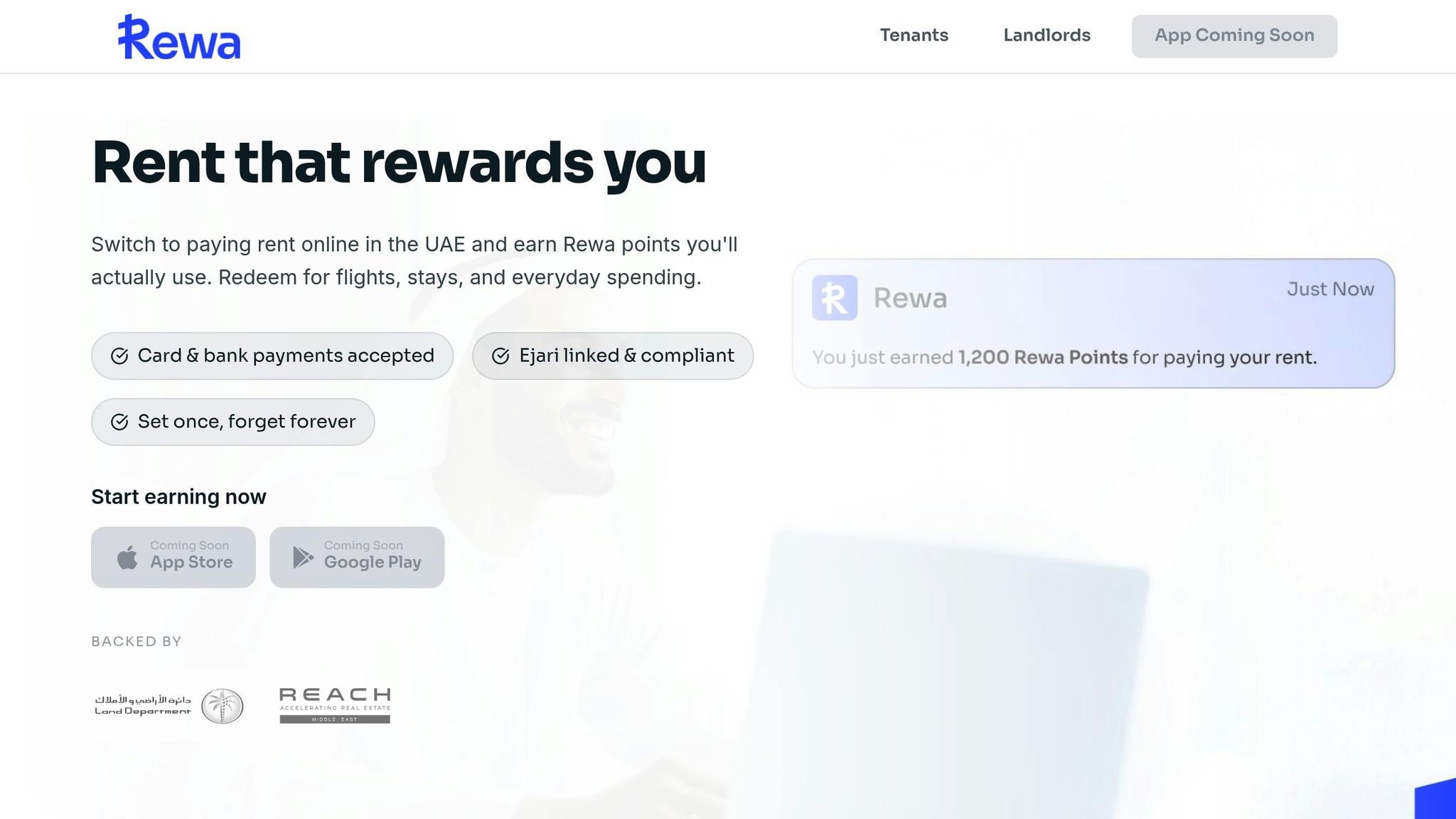
What Rewa Offers
Rewa replaces the need for traditional post-dated cheques with a digital platform that allows tenants to pay their rent using any UAE-issued Visa or Mastercard credit card - without hidden fees or extra charges. Operating under the Dubai Land Department's Real Estate Evolution Space (REES) initiative, Rewa adheres to local regulatory standards, aligning with the UAE's focus on automating rent payments.
Tenants benefit from earning double rewards on every transaction. They can combine their regular bank credit card points with Rewa-specific points, earning up to 2% of their annual rent back in rewards. These points can be redeemed with over 200 merchants, including Amazon, Noon, Carrefour, Netflix, and IKEA, or converted 1-for-1 into AirRewards points through Air Arabia.
Rewa employs UAE PASS and requires original Ejari certificates to verify tenant identities securely. It also boasts ISO 27001, ISO 27017, and CSA STAR Level 2 certifications, ensuring top-tier security. Payments are processed through UAE Central Bank-regulated Payment Service Providers. With this combination of rewards and robust security, Rewa reflects the UAE's push toward a more digitally advanced rental system.
How Rewa Works for Landlords and Tenants
Rewa's automated workflows make rent payments both efficient and rewarding, offering benefits for both landlords and tenants.
For landlords, Rewa ensures rent payments are always on time, transferring funds directly to their bank accounts on the due date without any deductions or fees. The platform automates reconciliation and portfolio tracking, removing the risks linked to cheque payments.
Tenants gain flexible payment options, turning their rent into an opportunity to earn rewards.
What's Next for Rent Payment Systems
The rental payment landscape in the UAE is set to evolve further, building on the secure and efficient systems already in place. Future advancements are expected to make the process even more seamless and rewarding for tenants and property managers alike.
AI and Machine Learning in Rent Collection
AI and machine learning are reshaping rent collection systems across the UAE. These technologies are already automating essential parts of the rental process through advanced analytics and tracking tools. With real-time transaction monitoring and portfolio insights, AI-driven systems help reduce administrative challenges and minimise collection risks. Moving forward, deeper automation is on the horizon, offering property managers tools to streamline utility payments and manage virtual rent accounts. These developments align with the UAE’s broader digital transformation goals.
As technology continues to improve payment efficiency, there’s also a growing focus on integrating rewards systems, linking rent payments with lifestyle perks.
Expanding Rewards to More Lifestyle Categories
Rewards programmes are becoming a key feature of the rental payment ecosystem, adding tangible value for tenants. Currently, these programmes offer benefits through over 200 merchants, including well-known brands like Amazon, Noon, Carrefour, Netflix, and VOX Cinemas. The future promises even greater expansion, with rewards expected to cover thousands of retailers and service providers, turning rent payments into a source of economic value.
Another emerging trend is the combination of credit card loyalty points with platform-specific rewards. This allows tenants to earn multiple types of points from a single rent payment, transforming a significant expense into an opportunity for financial gain. Additionally, partnerships with telecom providers like du and Etisalat enable tenants to redeem rewards for essential services, further enhancing household budgets and aligning with the UAE Digital Government Strategy.
These advancements are making rent payments not just a routine obligation, but a rewarding experience, continuing to elevate the UAE’s rental market.
Conclusion: The Future of Rent Payments in the UAE
The rental market in the UAE is undergoing a rapid transformation. Cash and cheque payments now account for just 16% of rent transactions, a significant drop from 25% only a year ago. This shift aligns with Dubai's goal of achieving 90% digital transactions by 2026. The traditional practice of paying rent in 1–4 cheques is giving way to more flexible options, such as 12 monthly instalments, bringing a fresh approach to the market.
Companies like Rewa are at the forefront of this change, turning rent payments into a more dynamic financial process. By automating payments, Rewa ensures on-time transactions without fees, creating benefits for both tenants and landlords.
AI-powered automation is also playing a key role. It simplifies communication, tracks payments in real time, and provides detailed portfolio insights that help reduce risks for landlords. Already, these technologies are being utilised across more than 10,000 rental units in the UAE, showcasing their effectiveness.
With government backing and advanced technology, the digital transformation of rent payments is not just a vision - it's already happening. As AI systems become more advanced and rewards programmes expand, the rental experience continues to evolve. The result? A system that is efficient, secure, and beneficial for all parties involved, setting a new standard for the rental market in the UAE.
FAQs
Can I switch from cheques to monthly rent without changing my tenancy contract?
Yes, it's possible to move from paying rent through cheques to making monthly payments without needing to change your tenancy contract. The UAE is gradually shifting towards monthly rent payments, with a target to implement this system by 2026. This modern approach aims to simplify the rental process and offer more flexibility to both tenants and landlords.
How secure are automated rent payments under UAE banking rules?
Automated rent payments in the UAE are highly secure, thanks to regulations set by the Central Bank. These fall under the Retail Payment Services and Card Schemes Regulation, which imposes strict standards on payment service providers. These rules cover licensing, operations, and contracts, ensuring both compliance and the safety of transactions.
How do I earn and redeem rewards on rent with Rewa?
With Rewa, paying rent becomes more than just a monthly task - it’s an opportunity to earn rewards. Whether you choose to pay via credit card or bank transfer, every payment helps you collect points. These points can then be redeemed for perks such as travel discounts, dining experiences, or fitness benefits. It’s a way to add extra value to your rent payments while promoting timely payments, turning your rental experience into something far more rewarding.