How Flexible Payments Help Landlords Plan Better
Use fixed monthly dates, digital collection and automation to make rent predictable, reduce delays, and improve cash-flow planning.
How Flexible Payments Help Landlords Plan Better
If I want rent income to be easier to plan, I need fixed monthly payment dates, digital collection, and clear rules. That is the core idea.
In this article, I show that flexible rent payments are not just about making life easier for tenants. They help me plan when rent will arrive, line it up with costs, and cut delays caused by cheques. In the UAE, that matters because bills such as maintenance, salaries, and finance payments usually run on a monthly cycle.
Here’s the full takeaway in simple terms:
- I can set monthly instalments instead of depending on large cheque payments
- I can match payment dates to a tenant’s salary cycle
- I can put exact terms in the tenancy contract, including AED amounts and DD-MM-YYYY due dates
- I can use digital payments like bank transfer, card payments, or UAEDDS
- I can automate reminders, autopay, receipts, and tracking
- I can use fixed landlord payout dates to plan cash flow
- I can track key numbers like:
- on-time collection rate
- average days late
- arrears share
- autopay adoption
- I should keep a cash reserve for repairs, vacancies, or delayed payments
- I need to apply the same payment rules to every tenant
A few numbers stand out. The article notes that automated digital collection can move on-time payment rates from 32% to 95%. It also cites portfolio figures such as a 97.2% collection rate, a 94.8% on-time rate, and a 98.4% live transaction success rate.
The main point is simple: when I collect rent in scheduled digital instalments and keep the process consistent, I get more control over cash flow and fewer surprises.
The rest of the article explains how to set the payment structure, automate collection, use payment data for forecasting, and keep tenant communication clear from day one.
Step 1: Design a payment structure that supports predictable cash flow
Before you offer flexible payment options, look at your monthly costs first and work backwards from the dates your bills are due. Start with timing, then put everything in writing.
Map your monthly costs and target payout dates
List your monthly costs and set rent collection dates before your biggest fixed outgoings are due. That gives you more control over cash flow and helps avoid last-minute gaps.
Choose instalment schedules that match tenant pay cycles
Use one fixed monthly instalment date that lines up with when the tenant is paid. A fixed date makes missed payments less likely and helps keep collections steady.
Write exact payment terms into the tenancy contract
The tenancy contract should clearly state the total annual rent in AED, each due date in DD-MM-YYYY format, the grace period, and exactly what happens if an instalment is missed. It should also name the payment method, such as UAEDDS, so the collection process is clear from day one.
Once the schedule is locked into the tenancy contract, automation helps keep collection on track.
sbb-itb-80e96b1
Step 2: Use digital collection and automation to reduce delays
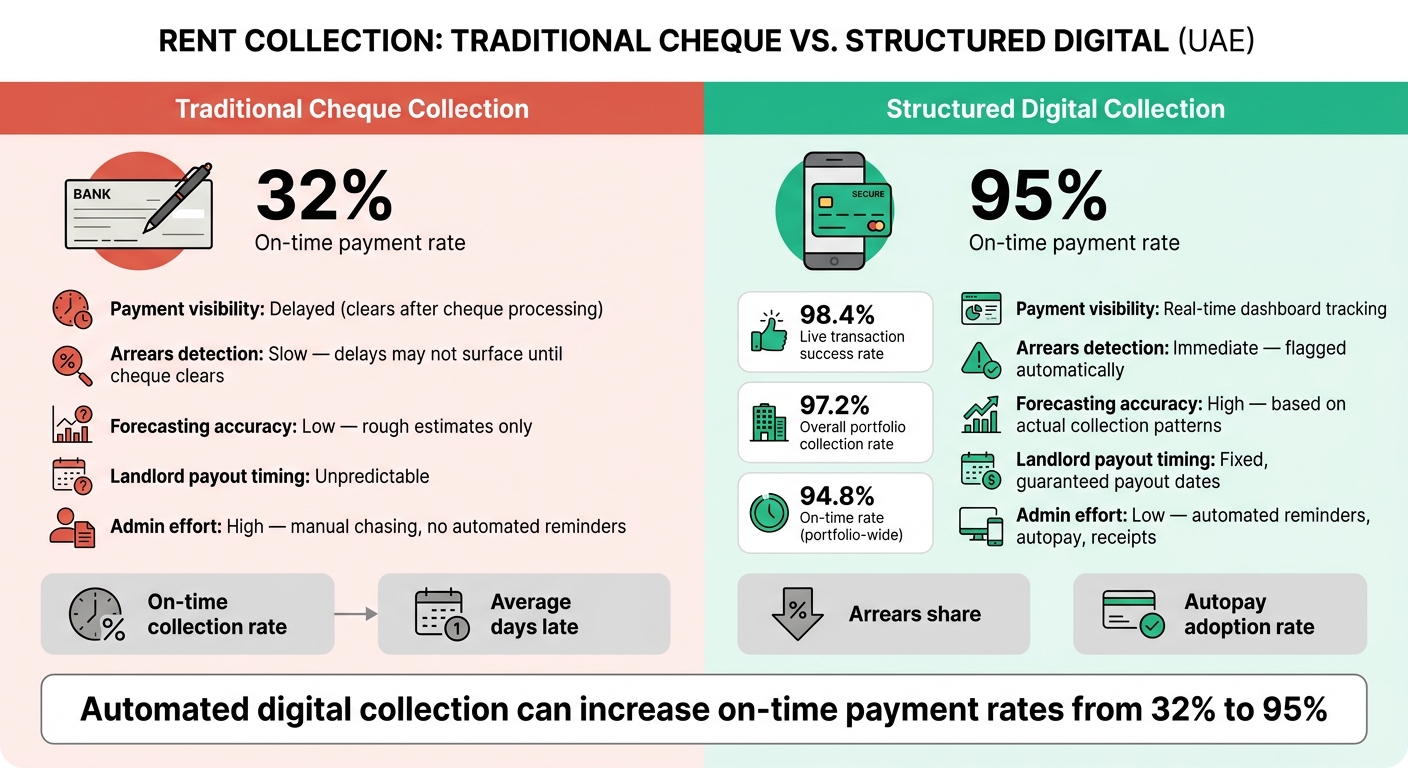
Traditional vs. Digital Rent Collection: Key Performance Metrics
Once the schedule is locked in, the next move is simple: automate collection so rent lands on time with less chasing.
Offer card and bank transfer options to remove payment friction
Give tenants simple ways to pay. Card and bank transfer options remove cheque-related hold-ups and make it easier to stick to the agreed schedule.
When tenants can pay by credit card - Visa or Mastercard - or by bank transfer, staying on track becomes much easier.
Rewa lets tenants pay rent digitally while earning rewards points redeemable for travel, dining, fitness, and more. It also creates a cleaner payment trail, which helps with forecasting in the next step.
Set up reminders, autopay, and payment tracking
A good digital system does the routine work for you. It sends reminders before each due date, runs recurring payments automatically, and shows pending and completed payments across your portfolio in one dashboard.
That kind of automation can make a big difference. Automated digital collection can increase on-time payment rates from 32% to 95%, and some platforms report a 98.4% success rate for live transactions.
Those fixed collection dates also make monthly forecasting easier to trust.
Fix landlord payout dates
For cash-flow planning, the biggest win is simple: you know exactly when rent will hit your account.
Guaranteed payout models let tenants pay in a way that suits them - by card or bank transfer - while the landlord still receives the full amount on the agreed date.
Rewa uses this model, with automated processing. Guaranteed payout dates give landlords fixed income timing even when tenants pay with more flexibility. Use those payout dates as the baseline for cash-flow forecasts and reserve planning.
Step 3: Turn payment data into cash-flow forecasts and controls
Once collection is automated, you get payment data you can actually use. The biggest win is turning that data into a monthly forecast.
Build monthly forecasts from actual collection patterns
A digital payment system gives you actual collection data, not rough guesses. You can see how rent comes in each month across units, buildings, or tenant groups. After a while, those payment habits become the base for your forecast.
Say a large group of tenants pays at the start of the month, while others tend to settle a bit later. That gives you a clearer picture of when cash will land. And that makes it easier to time mortgage payments, service charges, and maintenance spend with more confidence.
Rewa provides dashboards that track monthly collection and live payments, so you can monitor collection performance across your portfolio in real time. Portfolio-wide metrics from structured digital collection include a 97.2% overall collection rate and a 94.8% on-time rate.
Track the right KPIs and keep a reserve buffer
A small set of KPIs can tell you a lot about portfolio health:
- On-time collection rate - your main signal
- Average days late - shows if delays are getting worse
- Arrears share - shows exposure across the portfolio
- Autopay adoption - more adoption usually means better predictability
Tracking those numbers is only part of the job. You also need a practical reserve buffer. That buffer helps cover surprise repairs, a short vacancy, or a delayed payment without throwing off your outgoings. It also makes the gap between structured digital collection and cheques much easier to spot.
Compare traditional collection with structured flexible payments
Cheque-based collection can blur what’s going on. A delay may not show up until the cheque clears. Structured digital payments show timing, arrears, and payment behaviour in real time, so forecasts are tighter and reserve planning is much easier.
Once those numbers are visible, the next move is applying the same rules to every tenant.
Step 4: Communicate clearly and keep policies consistent
Once you can see payment patterns, the next job is to keep them steady. That starts with simple rules and the same process for every tenant. Flexible payments only work when tenants know exactly what applies from day one.
Explain the rules during leasing and onboarding
Add flexible payment terms to the tenancy agreement before move-in. The lease should spell out the due dates, any grace period, the late fee structure, and state that rent is treated as received when the digital receipt is issued.
During the move-in walkthrough, take tenants through the payment schedule and what happens if payment is late. If a tenant pays in instalments, show the exact dates, such as the 1st and 15th, and explain how those dates match the tenant's pay cycle. That simple step can remove a lot of confusion.
If you use Rewa, show tenants how to pay by card or bank transfer, and explain how rewards work. In the UAE, giving key instructions in both English and Arabic can help cut down misunderstanding.
"Tenants are more likely to pay on time when they know the rules are firm but applied fairly." - Sam Eddinger, Broker and Owner, Ironclad Property Management
Apply the same standards across all tenants
After onboarding, stick to the same process each time. Flexible payments should be structured, not casual. If you make a one-off exception for a tenant, such as moving a due date, document it clearly so it doesn't quietly turn into a new rule across the portfolio.
Use the same approval criteria for every tenancy. If a payment is missed, follow the same escalation sequence each time:
- Automated reminder
- Written notice
- The next contractual step
Written notices should include the date, the next step, and contact details.
This kind of consistency matters for more than collections. It also protects the accuracy of the payment data you use for cash-flow planning. When the same rules apply to every tenant, the collection patterns from Step 3 stay reliable, and your forecasts remain tied to actual behaviour.
Conclusion: Build flexibility into rent collection without losing control
Flexible rent collection gives landlords more control, not less. The steps in this guide follow a clear path, but the main outcome is simple: scheduled payments, automated collection, and clear data that helps make rental income more predictable.
In the UAE, this approach also fits current payment frameworks. Flexible rent collection can work within UAEDDS and Ejari-linked workflows, so payments stay scheduled and properly documented.
Rewards can also help support on-time payment habits. Rewa lets tenants pay by credit card or bank transfer while earning rewards points, while landlords receive on-time payments with no fees.
The result is predictable rent for landlords and simpler payments for tenants.
FAQs
How do I choose the right rent due date?
Choose a rent due date that fits your cash flow and lines up with your tenant’s pay schedule. That small decision can make a big difference: it often leads to steadier payments and fewer late transfers.
If you offer flexible payment arrangements, choose a date that makes monthly instalments easier for your tenant to manage. And if you use Rewa, automated processing and guaranteed on-time rent collection can take some of the pressure out of timing.
What if a tenant misses a monthly instalment?
If a tenant misses a monthly instalment, flexible rent payment systems can ease the pressure. Automated payments and payment schedules that line up more closely with the tenant’s income can help cut late payments and reduce financial stress.
In the UAE, Rewa also guarantees on-time rent collection for landlords with zero fees, ensuring full payment even if an instalment is missed.
How much cash reserve should a landlord keep?
A landlord should keep enough cash on hand to deal with the stuff that always seems to show up at the worst time: surprise repairs, routine upkeep, taxes, insurance deductibles, and a basic emergency fund.
A common rule of thumb is to set aside around 1–4% of the property’s value each year. Then add a bit more for costs you didn’t see coming.