Common Tenant Pain Points Solved by Rewards
Digital payments, rewards, and automation simplify UAE rent—flexible payment, points for on-time pay, and automated reminders.
Common Tenant Pain Points Solved by Rewards
If rent in the UAE feels rigid, stressful, and one-sided, the main fix is simple: move payments online, add rewards, and automate reminders.
I see three clear issues in the article: tenants often face large AED rent payments, strict cheque-based schedules, and no return at all on one of their biggest monthly costs. In a market with 1.38 million tenancy contracts in 2025, that creates pressure for both tenants and landlords.
Here’s the short version:
- Rigid payment methods make rent harder to line up with monthly salaries
- No points or perks means rent feels like money out with nothing back
- Manual follow-up adds stress, missed dates, and admin work
- Digital payments cut out cheques and manual transfer steps
- Rewards give tenants points for paying on time
- Automation helps with reminders, receipts, and payment tracking
- Landlords also get fewer payment issues and less admin
My takeaway: rewards do not just add perks. They help turn rent into a payment system that is easier to track, easier to pay, and more likely to support renewals.
| Issue | What fixes it | What changes |
|---|---|---|
| Rigid rent schedules | Card or bank payment options | Better fit with monthly cash flow |
| No value from rent | Points and partner perks | Some return on a large expense |
| Late-payment stress | Automated reminders and receipts | Fewer missed dates and less confusion |
| Manual admin | Digital tracking | Less back-and-forth for landlords and tenants |
So if I had to sum up the whole piece in one line, it would be this: when rent payments become digital, reward-based, and automated, the day-to-day renting experience gets simpler for everyone.
Common Tenant Frustrations With Rent Payments
Rigid Payment Methods and Large Fixed Commitments
For many UAE tenants, rent is expensive and tough to handle in one shot. A lot of leases still depend on PDCs and manual bank transfers, which means planning months in advance and dealing with paperwork. That can feel like a lot for something as routine as paying rent.
The problem gets bigger when payment schedules are quarterly or every six months, while most salaries come in monthly. That mismatch creates a cash-flow gap. Tenants either need to keep large cash reserves ready or scramble to cover the amount when it falls due. As Garima Kediya noted in Estate Magazine:
"Post-dated cheques, manual bank transfers, and paperwork-heavy processes often create delays, stress, and administrative burdens for both tenants and property owners."
That’s the point where rent stops feeling like a normal monthly bill and starts feeling like a cash-flow strain. These rigid terms are exactly where rewards-based rent tools can help.
No Rewards or Everyday Value From Rent
There’s also a plain value gap: for UAE residents, rent has long been just an expense, with no tangible return. The money goes out every month, but nothing comes back. Over time, that can make the whole setup feel one-sided.
When the same AED amount leaves your account again and again with no upside attached, rent starts to feel like dead money. Rewards change that a bit. They turn a fixed payment into a way to get some everyday value back, instead of treating rent as a cost with zero return.
Once rent feels heavy and offers no upside, even a small delay can feel harder to deal with.
Late-Payment Stress and Manual Follow-Up
Even tenants who usually pay on time can feel pressure. Without automated reminders or real-time tracking, due dates can slip by. And if a cheque bounces, the result can be penalties and disputes, which pushes the financial risk much higher.
Then there’s the admin side. Manual follow-ups, cheque handling, and paper-based reconciliation eat up time and make it harder to see payment status clearly. That friction hurts tenant satisfaction and adds avoidable work for property teams.
Instead of giving tenants a sense of control, the payment process often creates stress and uncertainty.
sbb-itb-80e96b1
How Rewards Programmes Fix These Rent Payment Problems
These pain points come down to three simple fixes: digital payment, rewards, and automation.
Digital Payment Options Cut Out Manual Steps
Digital payment options remove the hassle of cheques and manual bank transfers. Instead of planning around paperwork or bank timings, tenants can pay rent by credit card in AED and line that payment up with their card statement cycle. That can make monthly cash flow easier to handle.
For tenants who would rather pay straight from their bank account, pay-by-bank options make that possible through Open Finance direct debit setups.
Once rent payments move online, the next step is clear: give tenants a reason to care about the transaction beyond just getting it done.
Points and Perks Give Tenants Real Value
This is where rewards help close the value gap. Rewards-enabled rent platforms turn on-time rent payments into points that tenants can use with travel, dining, groceries, fitness, and lifestyle partners. So instead of rent feeling like money that simply leaves the account each month, it starts to give something back in day-to-day life.
As Ramzi Mneimneh of Rewa noted:
"We've applied proven loyalty models from the airline and hotel industries to rent, creating a system that rewards tenants while improving cash flow and efficiency for landlords."
Some platforms also let tenants use points towards future rent or utility bills.
Still, rewards on their own won't fix late payments. People also need clear prompts and easy records.
Automated Reminders Reduce Missed Due Dates
Keeping track of rent due dates manually adds stress that most tenants could do without. Digital platforms make this easier by showing due dates in DD/MM/YYYY format, sending automated reminders, and issuing digital receipts once a payment clears. That gives tenants a clear view of what’s due and when.
For landlords, the same setup makes collections easier to follow. Automated tracking and real-time dashboards show which payments have cleared, so on-time collection becomes the standard rather than the exception.
How Rewards Improve Retention and Property Performance
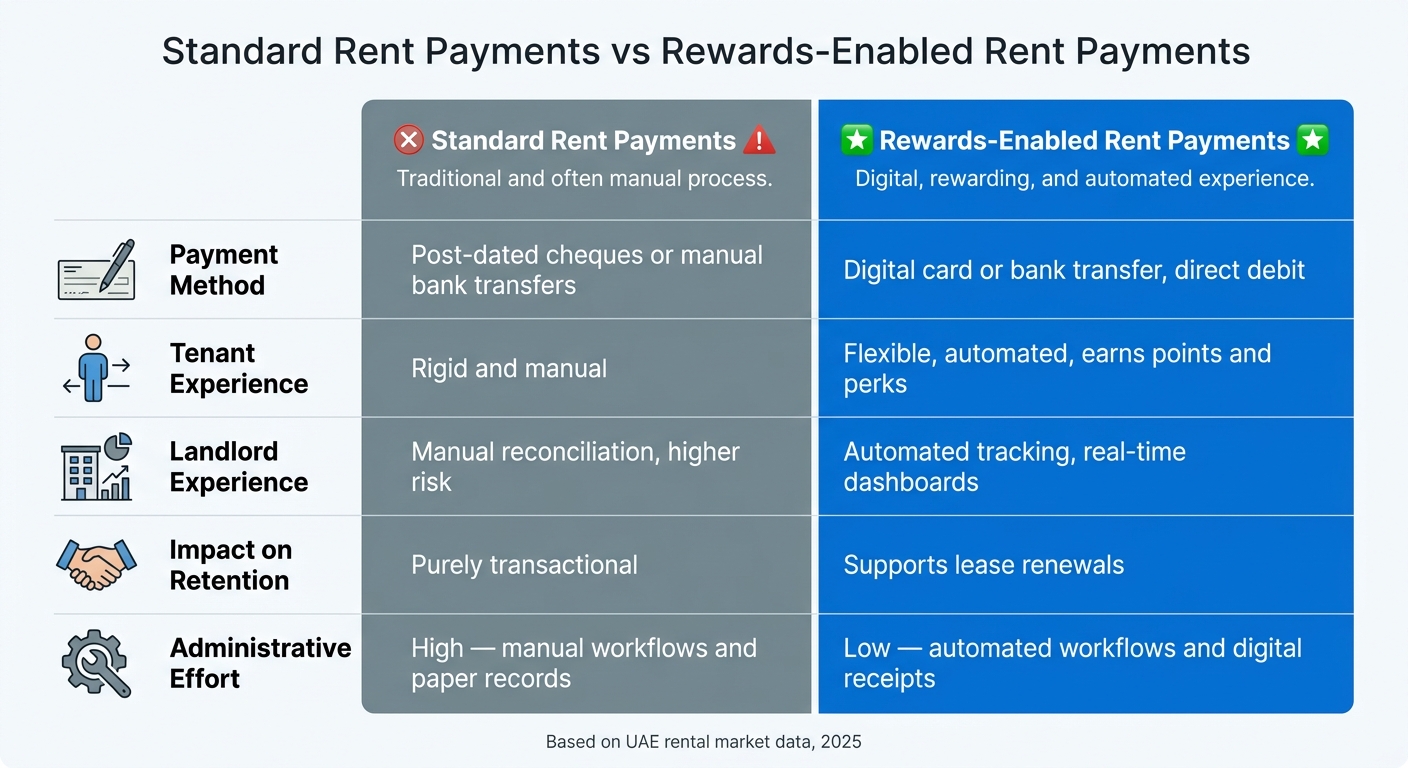
Standard Rent Payments vs Rewards-Enabled Rent Payments in the UAE
When rent feels easier to manage - and tenants get something back for paying it - it can start to shape renewal decisions.
Recognising Tenants Builds Loyalty and Encourages Renewals
Rewards make rent feel less one-sided. Instead of being just another monthly cost, it becomes a payment that gives something back. That shift can strengthen renewal intent. If points can be used to lower future rent or utility bills, tenants have a clear reason to stay when the lease is up.
Practical Gains for Landlords and Property Managers
For landlords and property managers, the upside is practical too. Moving away from post-dated cheques can cut bounced-cheque risk and reduce manual reconciliation. Digital logs and automated receipts give both sides one clear record, which helps reduce disputes. In plain terms, tenants get a smoother payment experience, and landlords spend less time sorting out admin.
Keeping a tenant is also usually less expensive than replacing one, especially once marketing, cleaning, and commission fees are factored in.
Comparison Table: Standard Rent Payments vs Rewards-Enabled Rent Payments
The difference is easy to spot in day-to-day operations.
| Feature | Standard Rent Payments | Rewards-Enabled Rent Payments |
|---|---|---|
| Payment Method | Post-dated cheques or manual bank transfers | Digital card or bank transfer, direct debit |
| Tenant Experience | Rigid and manual | Flexible, automated, earns points and perks |
| Landlord Experience | Manual reconciliation, higher risk | Automated tracking, real-time dashboards |
| Impact on Retention | Purely transactional | Supports renewals |
| Administrative Effort | High | Low - automated workflows and digital receipts |
Rewa as a Working Example and Key Takeaways
How Rewa Turns Rent Into Rewards
Here’s how those fixes play out in day-to-day renting.
Rewa turns rent into a digital payment that earns reward points when tenants pay on time. Tenants can pay by credit card or bank transfer, then collect Rewa Points that they can redeem with more than 150 partners across travel, dining, retail, and lifestyle.
The same setup also helps owners. For landlords, Rewa automates secure payment processing, tracking, and receipts, with no fees and guaranteed on-time payments.
That’s why this model matters for retention.
Conclusion: Better Rent Experiences Lead to Stronger Retention
In practice, these changes make rent simpler to pay and simpler to manage. The core issue is straightforward: rigid payment methods, no perks, and the stress of late payments chip away at tenant satisfaction.
Digital payments cut the manual work. Rewards help fix the value gap. Automation keeps due dates on track.
When those three pain points are dealt with, tenants have a clear reason to stay. At the same time, landlords spend less time chasing collections. A smoother rent experience can support renewals, lower admin work, and reduce vacancy risk.
FAQs
Can I split rent into monthly payments?
Rewa lets you manage rent digitally with a scheduled payment system. You can pay by credit card or bank transfer, and track upcoming rent payments in the app.
It works with your existing rental agreement, so there’s no need to change your lease structure. At the same time, it gives you more flexibility than cheque-based rent payments.
What rewards can I earn on rent?
When you pay rent on time through Rewa, you automatically earn Rewa Points. Then you can use those points with 150+ global and local partners across travel, retail, groceries, dining, and lifestyle.
You can also put your points towards future rent payments, utility bills, and long-term housing goals with select UAE developers. If you prefer, you may convert them into airline miles through partner loyalty programmes.
How do automated rent reminders work?
Rewa replaces manual tracking with automated payment oversight. It keeps a digital payment schedule, shows upcoming rent obligations and payment status in real time, and issues digital receipts.
That means less back-and-forth, fewer manual follow-ups, and less time spent on account reconciliation for landlords and property managers. At the same time, both tenants and landlords get a clear, reliable record of every transaction.