Bank Transfers vs Cheques for Rent Payments
Compare bank transfers and cheques for UAE rent: speed, security, costs and convenience, plus how direct-debit systems and platforms simplify payments.
Bank Transfers vs Cheques for Rent Payments
Bank transfers are quickly replacing cheques in the UAE rental market. Cheques have been a long-standing method for rent payments, but digital options like bank transfers and platforms such as Rewa are now offering faster, safer, and more convenient alternatives. Here's a quick breakdown:
- Bank Transfers: Instant (or near-instant) payments, secure, automated, and easy to track. However, errors in account details or fraud risks can cause issues. Some transfers may also include fees.
- Cheques: Widely accepted, provide a sense of commitment, and can sometimes secure rent discounts. But they involve manual handling, risk of loss, and administrative challenges, especially for overseas landlords.
The shift to digital payments is gaining momentum, driven by initiatives like the UAE Central Bank's Direct Debit System (UAEDDS) and platforms like Rewa, which simplify rent payments and offer additional perks like rewards for tenants. Below is a quick comparison of the two methods:
Quick Comparison
| Criteria | Bank Transfers | Cheques |
|---|---|---|
| Speed | Instant to 1–3 business days | Requires manual deposit and clearance |
| Security | Encrypted, less prone to errors | Risks of loss, theft, or mismatched signatures |
| Convenience | Automated, no physical handling | Requires manual tracking and handling |
| Flexibility | Monthly instalments possible | Limited flexibility with fixed cheque dates |
| Costs | Possible fees for some transfers | No direct fees but risk of penalties for bounced cheques |
Conclusion: Bank transfers are overtaking cheques as the preferred rent payment method in the UAE, offering more convenience and reliability for both tenants and landlords. Platforms like Rewa are further transforming the process by integrating rewards and automation, making rent payments simpler and more efficient.
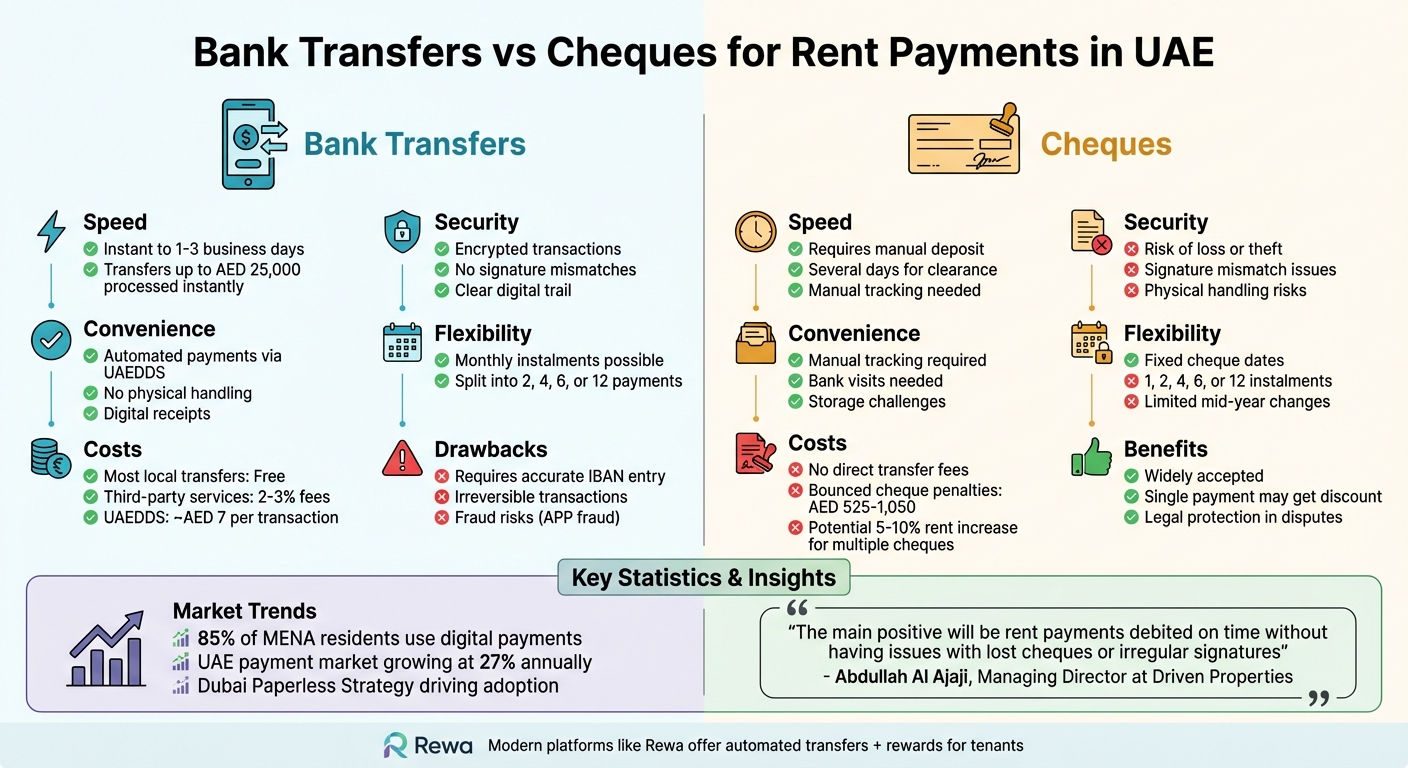
Bank Transfers vs Cheques for Rent Payments in UAE: Complete Comparison
The Basics of Business Banking: Checks, ACHs and Wire Transfers
Bank Transfers for Rent Payments
Bank transfers are becoming a popular choice for rent payments in the UAE, offering a digital alternative to the traditional cheque system. Understanding their benefits and limitations can help tenants make informed decisions.
Benefits of Bank Transfers
One major advantage of bank transfers is speed. Transfers within the UAE for amounts up to AED 25,000 are processed instantly by banks like FAB. Larger sums typically clear within the same or next business day, while standard transfers take 1–3 business days, as long as they are initiated before 4 p.m. on working days.
Another key benefit is security. Digital transfers eliminate risks such as lost cheques or issues with incorrect signatures. The encrypted nature of these transactions ensures that financial details remain protected.
"Sometimes there are issues with cheques like the signature doesn't match and there is a possibility of the cheques bouncing. Also, if the owner is overseas and the cheque needs to be returned, the bank will only hand it back to the landlord." - Emma Jayne Main, Head of Leasing, Espace Real Estate
Automation is another perk. Tenants can set up Automatic Standing Instructions or use the UAE Central Bank's Direct Debit System (UAEDDS) to ensure timely rent payments without manual effort each month. The UAEDDS even allows tenants to split rent into 2, 4, 6, or 12 instalments, offering flexibility in managing cash flow. This feature is especially helpful for landlords living overseas, who can avoid the hassle of dealing with physical cheques.
Bank transfers also provide transaction tracking, creating a clear digital record of payments. Each transfer generates a receipt, making it easier to resolve disputes and maintain proper financial documentation. This transparency benefits both tenants and landlords by ensuring a reliable payment trail.
Despite these advantages, there are some challenges to consider.
Drawbacks of Bank Transfers
One issue with bank transfers is the need for accuracy. Tenants must carefully verify the landlord's IBAN and account details before each transaction. Errors in digital transfers can lead to delays or even result in funds being sent to the wrong account, which can be difficult to recover. Unlike cheques, where banks might catch obvious mistakes, the responsibility for accuracy rests entirely on the tenant.
Processing fees are another concern. While many UAE banks waive fees for standard local transfers, using third-party services for credit-card-to-transfer payments can incur charges of 2%–3%. International transfers often come with higher costs, such as SWIFT fees of approximately AED 100 plus additional correspondent bank charges. Even the UAEDDS may apply a convenience fee of around AED 7 per transaction.
Timing is also a factor. Manual transfers require careful planning since they can take 1–3 business days to process. Tenants need to ensure payments are made in advance to avoid delays. Unlike post-dated cheques, which can be prepared ahead of time, bank transfers require funds to be available at the moment of transfer, which might not always align with a tenant’s cash flow.
Finally, the irreversibility of bank transfers poses a risk. Once a transfer is completed, it cannot typically be undone. This can expose tenants to scams like Authorized Push Payment (APP) fraud, where fraudsters impersonate legitimate landlords. In cases of fraud or errors, tenants have limited options for recourse compared to credit card payments, which often allow disputes or chargebacks.
Cheques for Rent Payments
In Dubai, cheques remain a common way to pay rent, often structured into 1, 2, 4, 6, or 12 instalments based on lease agreements. While this system has its perks, it also comes with its fair share of challenges.
Benefits of Cheques
Cheques offer several advantages in rental transactions. For landlords, they provide a sense of security, as post-dated cheques represent a tangible financial commitment from tenants. Niral Jhaveri, Head of Property Management at Betterhomes, highlights this by saying:
"Most of the landlords are comfortable with the traditional method of holding on to cheques as it gives them a sense of security".
For tenants, paying rent in fewer cheques can be a strategic move. Offering to pay the entire year upfront in one cheque often leads to discounts on the total annual rent. On the other hand, landlords may raise the annual rent by 5–10% if tenants opt for 6–12 instalments instead of a single payment. This flexibility allows both parties to align payments with their financial needs - landlords can access immediate funds for mortgages or property upgrades, while tenants can synchronise payments with their monthly income.
Additionally, cheques provide a layer of legal protection in case of disputes. Although the UAE has decriminalised many aspects of bounced cheques, a physical cheque still serves as a formal financial commitment, which can be used in civil cases over unpaid rent. Moreover, cheques in the UAE are generally valid for up to six months from their issuance date.
Despite these benefits, there are notable challenges associated with this system.
Drawbacks of Cheques
Cheques, while widely used, come with several drawbacks. Administrative work is one of the biggest hurdles - landlords need to manually track, store, and deposit cheques on their due dates. This process can be time-consuming, especially compared to digital payment systems.
Human errors are another concern. Cheques can fail due to signature mismatches or alterations, leading to penalties. Real estate firms in Dubai may charge fines ranging from AED 525 to AED 1,050 for bounced cheques.
The risk of physical handling also poses challenges. Cheques can be lost, stolen, or misplaced, causing delays and security issues. For landlords living abroad, the situation is even trickier - if a cheque bounces, banks typically return the physical cheque only to the account holder, making recovery difficult for landlords based outside the UAE.
For tenants, cash flow management can be a challenge. Paying the entire rent in a single cheque places a heavy financial burden upfront and limits flexibility in case of mid-year contract terminations or renegotiations. Tenants must also ensure their accounts have sufficient funds 2–3 days before the cheque date to avoid fines or legal issues.
sbb-itb-80e96b1
Bank Transfers vs Cheques: Direct Comparison
Now that we've broken down the details of each payment method, let's see how they compare side-by-side in the UAE rental market.
Speed and Processing Times
Bank transfers and direct debits are instant. With digital payment systems like UAEDDS, transactions are automated and funds are transferred on scheduled dates without delays. In contrast, cheques require manual handling - depositing at the bank and waiting several days for clearance.
Dubai's push towards digital payments aligns with the "Dubai Paperless Strategy." Initiatives like the integration of the Ejari system with platforms from banks such as Emirates NBD are phasing out manual cheque systems. This shift has also introduced more flexible payment options, such as monthly instalments, which were cumbersome to manage with cheques.
Beyond just speed, security is another area where these methods diverge.
Security and Fraud Prevention
Digital transfers offer stronger security measures compared to cheques. They eliminate common issues like signature mismatches and formatting mistakes, which can delay or even reject payments. Additionally, the risk of losing or misplacing physical cheques is entirely avoided with digital transactions.
"The main positive will be rent payments debited on time without (landlords) having issues with lost cheques or irregular signatures" - Abdullah Al Ajaji, Managing Director at Driven Properties
Digital payments also provide a clear trail of transactions through online receipts and bank statements, making record-keeping and dispute resolution much simpler. Automated systems like UAEDDS further minimise fraud risks, such as forged signatures or altered documents. On the other hand, while the UAE has eased penalties for bounced cheques, physical cheques still carry risks for tenants.
After security and speed, convenience is another area where these payment methods differ significantly.
Convenience for Tenants and Landlords
Digital transfers are far more convenient than cheques. Cheques require physical handling, manual tracking, and regular trips to the bank for deposits - tasks that digital systems automate entirely.
For landlords, digital systems simplify property management by automating due date tracking and removing the need to store physical cheques securely.
"Such collaborations will help facilitate and streamline the processes involved in the property market by employing progressive machinations on the path towards replacing the legacy systems in place" - Sultan Butti bin Mejren, Director-General of Dubai Land Department
Flexibility is another major advantage of digital payments. Tenants can easily set up recurring payments or adjust schedules - monthly, quarterly, or otherwise - without the hassle of issuing multiple post-dated cheques. Both parties also benefit from instant digital confirmations, eliminating the need for manual receipts or waiting for cheque clearance. This is particularly helpful for overseas landlords, who often face challenges managing physical cheques and resolving signature mismatches from afar.
Rewa: A Modern Rent Payment Platform
As the UAE continues to embrace digital payments, Rewa steps in to transform rent collection with a secure and streamlined system. By automating transfers and offering rewards, the platform tackles the common hassles of traditional rent payments - like manual processing, delays, and administrative headaches.
Rewa is entirely free to use - tenants, landlords, and property managers face no credit card fees or hidden reward charges. This modern solution not only ensures secure transactions but also delivers real perks for everyone involved.
Benefits for Tenants
For tenants, Rewa offers a dual advantage: rewards and convenience. Each rent payment earns reward points that can be redeemed for lifestyle perks like travel, dining, and fitness. Since the platform supports credit card payments, tenants can double up on benefits by earning both credit card rewards and Rewa loyalty points. Credit card payments also provide much-needed financial flexibility, allowing tenants to break down hefty rent payments into manageable monthly instalments - an invaluable option during emergencies. With automated transactions, tenants no longer have to worry about tracking due dates or making trips to the bank to deposit cheques.
Benefits for Landlords
Rewa simplifies life for landlords too. Automated fund transfers mean rent payments arrive on time without any manual follow-up. The platform eliminates the hassle of processing cheques, while also reducing risks tied to lost documents, mismatched signatures, or missed deposit deadlines. A user-friendly digital dashboard keeps landlords in the loop, providing real-time insights into property payments and boosting transparency. For landlords based overseas, the platform removes the logistical challenges of handling physical cheques and verifying signatures. Plus, Rewa’s zero-fee structure encourages widespread adoption, ensuring a smoother rent collection cycle and stronger tenant retention.
Conclusion
The UAE rental market is steadily shifting from traditional cheque payments to modern digital solutions that prioritise speed, security, and ease of use. While cheques have served as a staple for decades, they bring administrative challenges and lack the flexibility many tenants and landlords now seek.
With 85% of MENA residents embracing digital payments and the UAE’s payment market expanding at an impressive 27% annually, this transition is gathering momentum. Initiatives such as Dubai's Paperless Strategy and the UAE Central Bank's Direct Debit System are paving the way for monthly rent payments to become the norm.
This evolution is also driving the rise of platforms like Rewa. For tenants, Rewa transforms the rental process by replacing hefty upfront payments with manageable monthly instalments that align with their income cycles. Additionally, credit card payment options provide flexibility and even rewards for each transaction. For landlords, the platform’s automated system ensures timely payments while cutting down on administrative tasks.
"By easing the financial burden of large upfront rental payments, we're helping new residents establish themselves more easily and build long-term roots in the country" - Michael Lahyani, Founder and CEO of Property Finder
This shift highlights how technology is redefining the rental experience in the UAE, making it simpler and more accessible for everyone involved.
FAQs
What makes bank transfers more secure than cheques for rent payments?
Bank transfers offer a secure and dependable alternative to paying rent compared to cheques. The automated process directly deducts the payment from the tenant's account, eliminating concerns about bounced cheques or inadequate funds. This not only ensures payments are made on time but also reduces the likelihood of mistakes or fraudulent activity.
Moreover, bank transfers rely on advanced digital security systems, providing strong protection against tampering or forgery. For landlords, this means a hassle-free and reliable payment experience, while tenants enjoy the ease and reassurance that come with this method.
How does the UAE Central Bank’s Direct Debit System make rent payments easier?
The UAE Central Bank's Direct Debit System (UAEDDS) has made rent payments much easier by automating the entire process and eliminating the need for physical cheques. With just one authorisation, tenants can allow landlords to deduct rent directly from their bank accounts or credit cards. This creates a seamless and stress-free way to handle payments.
One of the standout benefits of this system is its added security, as it operates under the Central Bank's regulations. It also removes the worry of bounced cheques due to insufficient funds. Tenants enjoy more control too, as they can cancel the mandate whenever they wish. For landlords, UAEDDS ensures on-time, automated payments, cutting down on administrative tasks and saving valuable time. In short, UAEDDS streamlines the rent payment process, making it quicker, safer, and more convenient for everyone in the UAE.
What challenges might tenants face when paying rent via bank transfer in the UAE?
Tenants in the UAE should keep a few potential hiccups in mind when paying rent through bank transfers. One frequent problem is the possibility of delays or failed transactions. These can occur for various reasons, like insufficient funds in the account, technical glitches, or even banking system downtime. Such delays could lead to late payment fees or misunderstandings with landlords.
Another challenge is the absence of instant payment confirmation. Without immediate verification, both tenants and landlords might feel unsure about whether the payment has gone through successfully. Additionally, factors like banking hours, public holidays, or scheduled system maintenance can interfere with timely processing of transfers.
To minimise these risks, tenants should double-check that their accounts have enough funds, plan transfers well in advance, and consult their banks about processing times to ensure smooth transactions.