How Bank Integration Improves Rent Collection
Use bank-connected payments to remove cheque delays, automate reconciliation, and give landlords real-time visibility of rent.
How Bank Integration Improves Rent Collection
Rent collection works better when payments move straight through bank links instead of cheques. In Dubai alone, 1.38 million tenancy contracts were registered in 2025, worth AED 126.4 billion. But many landlords still deal with cheque deposits, clearing delays, manual follow-up, and payment matching by hand.
If I strip the article down to its core point, it’s this: bank integration cuts delay, admin, and payment errors. It does that by moving rent through bank rails, matching payments to the right lease in real time, and keeping a clear digital record for each transaction.
Here’s the short version:
- Cheques slow cash flow because deposits and clearing take days
- Manual reconciliation creates mistakes when payments look similar or references are missing
- Limited payment options lead to more late rent
- Bank-connected payments fix this with auto-collection, live status updates, and cleaner records
- Landlords get better visibility into paid, pending, and failed rent
- Tenants get an easier way to pay without cheque books or branch visits
- Digital records support DLD and Ejari paperwork with less paper handling
Quick Comparison
| Area | Cheque-based rent collection | Bank-connected rent collection |
|---|---|---|
| Payment timing | Cleared after deposit and bank processing | Sent on due date through bank rails |
| Admin work | High; deposit, track, and match by hand | Lower; system collects and matches payments |
| Error rate | More room for lost cheques and wrong matching | Less room for manual mistakes |
| Payment visibility | Limited until cheque clears | Live view of payment status |
| Tenant experience | Cheque book or manual transfer needed | Pay from bank account, app, or card option |
| Records | Paper-heavy trail | Clear digital transaction history |
So if you want the plain answer: bank integration makes rent collection faster to track, easier to reconcile, and less work for both landlords and tenants.
Allocate rental payment directly from your bank statement with RentBook’s new features
sbb-itb-80e96b1
Common rent collection problems without bank integration
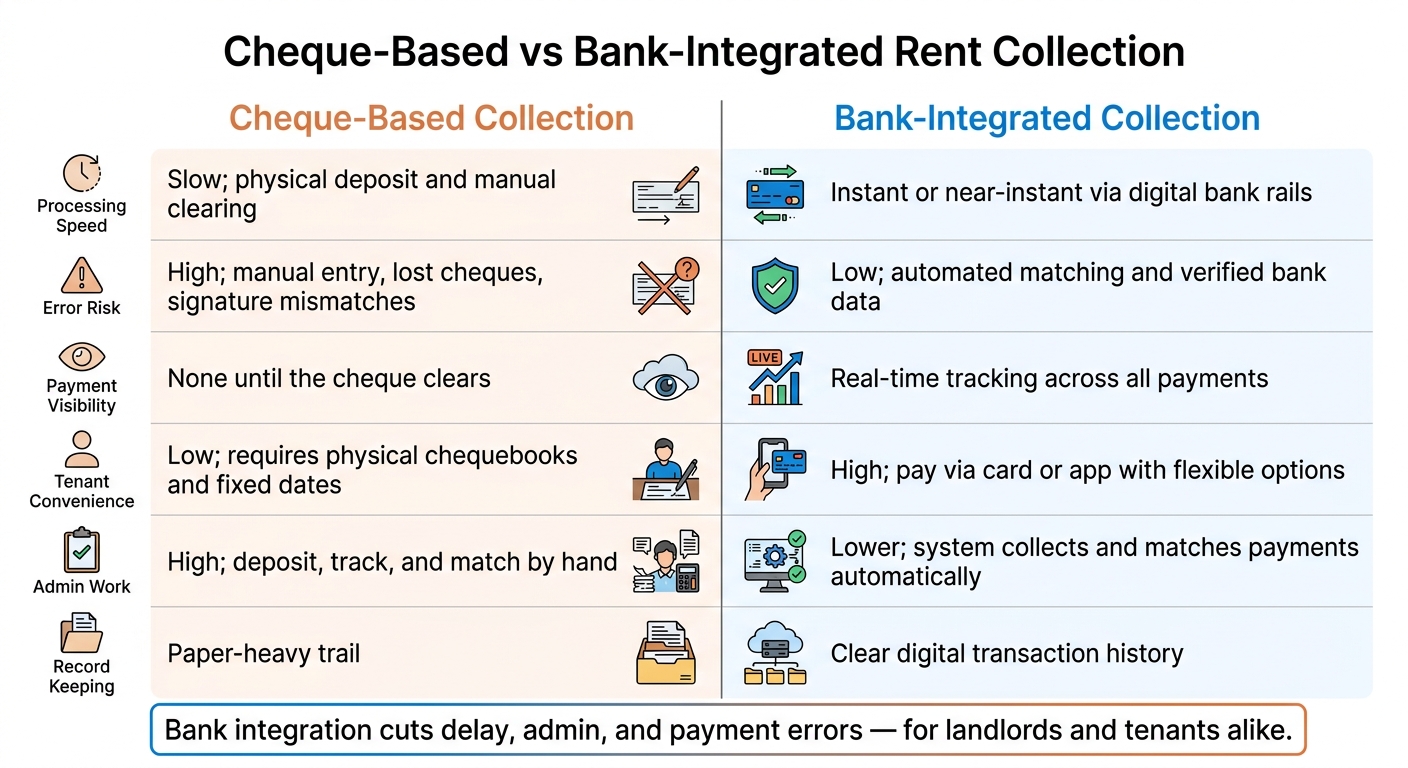
Cheque-Based vs Bank-Integrated Rent Collection: Key Differences
Manual rent collection adds friction at every step. For landlords with multiple units, it turns into repeated admin work: tracking due dates, depositing cheques, and reconciling payments at month-end.
Slow payments and delayed clearing lead to more late rent
In a cheque-based workflow, delay is built in. A cheque doesn’t clear on the due date. The deposit process and bank clearing can take several business days, so cash flow moves slower than expected. In many cases, landlords don’t even know a payment has arrived until they check it by hand.
Manual reconciliation causes errors and extra admin work
Matching each payment to the right tenant, unit, and lease gets messy fast when references are missing or payment amounts look the same. For larger portfolios, manual reconciliation also slows income forecasting and makes it less dependable.
Limited payment methods reduce on-time payment rates
Limited payment options make things harder for tenants too. When rent has to be paid by cheque or manual transfer, delays become more likely. It’s not always a refusal to pay. Sometimes it’s just friction, and friction tends to push payment further down the to-do list.
The table below shows how cheque-based collection compares with bank-integrated collection in the areas that matter most day to day:
| Feature | Cheque-Based Collection | Bank-Integrated Collection |
|---|---|---|
| Processing Speed | Slow; physical deposit and manual clearing | Instant or near-instant via digital bank rails |
| Error Risk | High; manual entry, lost cheques, signature mismatches | Low; automated matching and verified bank data |
| Visibility | None until the cheque clears | Real-time tracking across all payments |
| Tenant Convenience | Low; requires physical chequebooks and fixed dates | High; pay via card or app with flexible options |
These are the gaps bank integration removes: faster collection, cleaner reconciliation, and clearer control.
How bank integration improves rent collection
Bank integration removes a lot of the friction from rent collection in three main ways: automated collection, automatic matching, and secure records.
Automated payment collection through connected bank rails
Connected bank rails let rent be collected automatically on the due date once the tenant authorises the setup. Bank-integrated systems use the CBUAE Open Finance Framework so tenants can pay rent straight from their bank accounts in AED. After approval, the system collects the rent on the due date without cheques, manual bank transfers, or back-and-forth follow-ups.
In June 2026, Rewa partnered with Open Finance provider Spare to bring this to Dubai’s rental market. Through Spare’s API, Rewa can collect rent digitally through connected bank rails and skip the cheque-handling process altogether.
Real-time reconciliation and clearer rent reporting
When rent moves through bank rails, the payment data moves with it. That means each payment can be matched to the right lease and unit automatically, which cuts down on manual cross-checking.
Landlords get a clearer view of what’s happening, including:
- Paid payments
- Pending payments
- Failed payments
There’s no need to wait for a cheque to clear or go back to a bank statement later to work out what happened.
Secure processing with stronger compliance and audit trails
The same digital flow also improves security and record-keeping. Tenants authorise payments through their own banking interface, and each transaction creates a verified record. No card numbers or login details are shared with the property platform.
That matters for DLD and Ejari record-keeping too. Instead of relying on the paper trail that cheques used to provide, landlords and property teams have a clear digital record tied to each transaction.
What landlords and tenants gain from a bank-connected rent system
When rent runs through connected bank workflows, the upside shows up fast in day-to-day life. Landlords get paid with less back-and-forth. Tenants get an easier way to stay on top of rent. In plain terms, that means faster cash flow, less admin, and a smoother payment experience.
Landlords get faster cash flow and fewer collection issues
Connected bank rails replace cheque chasing with real-time payment status and clearer forecasting. That gives landlords a better view of what’s coming in and when.
It also cuts admin work. The system matches payments on its own and issues digital receipts that line up with DLD and Ejari workflows.
Tenants get a simpler and more flexible way to pay rent
For tenants, rent day becomes much easier. There’s no cheque book, no branch visit, and no manual bank transfer to remember every month. Once the payment setup is authorised, the rent is handled automatically.
There’s also more breathing room in how rent gets paid. Credit card and bank transfer options can help tenants avoid one big rent payment and keep cash on hand. That matters in a market that has long leaned on annual or multi-cheque payment schedules.
How Rewa adds rewards and on-time payment confidence
Rewa adds rewards on top of the payment ease. Tenants earn Rewa Points on every on-time payment, redeemable with over 150 global and local partners across travel, dining, retail, and groceries, or used to offset future rent and utilities.
For landlords, Rewa adds more confidence around on-time payments without extra fees, backed by secure automated processing.
Conclusion: Bank integration makes rent collection faster, cleaner, and easier to manage
Manual rent collection built on cheques and manual follow-ups slows payments, throws records out of sync, and piles on admin work. Bank integration removes those roadblocks.
It fixes the process at the source. Automated payment rails help rent move faster, while real-time dashboards give landlords a clear view across their portfolios. At the same time, the digital audit trail is much cleaner, which helps with DLD and Ejari record-keeping and cuts down on paperwork.
For tenants, rent payments no longer depend on a cheque book. Flexible payment methods and Auto-Pay make it much easier to stay on schedule each month.
Rewa turns rent into rewards: tenants pay by credit card or bank transfer, earn points redeemable across travel, dining, fitness, and more, and landlords get secure automated payments with on-time payment guarantees and no fees.
FAQs
How does bank integration reduce late rent?
Bank integration helps cut late rent by replacing manual steps and paper cheques with automated digital payments. That means fewer delays, fewer mistakes, and a much smoother payment flow. Transactions are faster, more secure, and easy to track from start to finish.
It also gives landlords real-time visibility into incoming payments, so they’re not left guessing or chasing updates. Less manual follow-up means less admin work too. On platforms like Rewa, reward-based features can give tenants an extra nudge to pay on time, which helps make rent collection more dependable.
Is bank-connected rent collection secure?
Yes. Rewa uses secure, verified transactions backed by the Central Bank of the UAE’s Open Finance Framework. That means tenants can pay straight from their bank account through direct, authenticated payments, without sharing card numbers or banking login details.
Rewa also works in line with relevant UAE rental, tenancy and financial rules, which helps keep digital rent collection secure and compliant.
Can tenants still pay flexibly without cheques?
Yes. With Rewa, tenants can pay rent in a flexible way without cheques, using a credit card or direct bank transfer.
That means no manual transfers and no physical post-dated cheques. Payments stay secure, smooth, and fully digital. On top of that, tenants earn reward points on every on-time payment.